













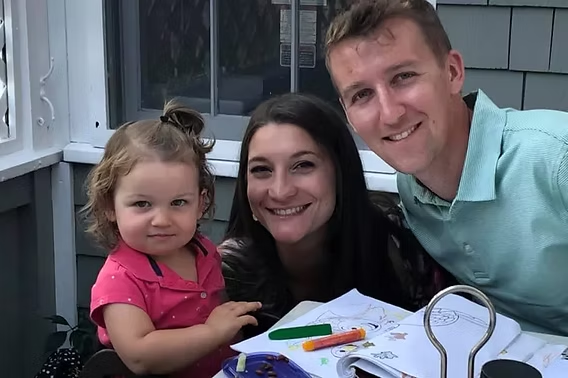
Lindsay Clancy—the name enters the room before the details do, heavy with a winter silence that still seems to cling to the small Massachusetts town where a family’s ordinary evening collapsed into something unthinkable. Snow muffled the streets. The house lights were on. Inside, time fractured. In the aftermath, the country would search for explanations—medical, moral, legal—while a single name became a shorthand for grief, rage, and a deeper unease about how modern life handles invisible suffering.
A domestic scene that refused to stay private
The story of Lindsay Clancy resists the tidy arc of a crime narrative. It begins not with spectacle but with the ordinary architecture of American family life: a suburban home, a mother balancing work and care, the constant low hum of expectation. The shock that followed did not only rupture one household; it cracked open a national conversation about postpartum mental illness, the limits of community vigilance, and the stories we tell ourselves about who is safe and who is not.
In the weeks after the tragedy, coverage ricocheted between horror and speculation. But beyond the headlines lay a more unsettling question: what happens when the systems meant to detect distress—medical, familial, social—fail quietly, all at once?
Origins, context, and the anatomy of a breakdown
To understand the cultural gravity of Lindsay Clancy, it helps to situate the case within a broader medical and social landscape. Postpartum mental health conditions exist on a spectrum, from depression and anxiety to rarer but severe disorders. According to the National Institutes of Health, postpartum depression affects a significant share of new mothers, often emerging months after childbirth rather than immediately, complicating detection and treatment (lindsay clancy).
The term “postpartum psychosis,” frequently invoked in public discussion, is itself often misunderstood. It is rare, abrupt, and dangerous, characterized by delusions, disorganized thinking, and a break from reality. Medical literature emphasizes urgency: this is a psychiatric emergency. Yet rarity can breed complacency, both in families and in healthcare systems stretched thin.
Lindsay Clancy’s name became entangled with these clinical terms not because she represented them neatly, but because the case exposed how poorly the public understands them—and how devastating the consequences can be when understanding arrives too late.
The digital echo chamber of grief and judgment
As the story spread, it metastasized online. Comment sections hardened into camps: those demanding punishment, those pleading for compassion, many oscillating between the two. This pattern is not new. Sociologists have long noted how social media collapses nuance, especially around crime and motherhood. A mother who harms is cast as an aberration, a violation of an almost sacred cultural script.
Wikipedia’s overview of postpartum depression traces how the condition has historically been minimized or romanticized, often framed as “baby blues” rather than a serious illness (Postpartum depression ). In the Lindsay Clancy discourse, that minimization collided with visceral loss, producing an especially volatile mix.
What emerged was not clarity but amplification—each hot take sharpening the sense that something had gone fundamentally wrong long before a single, catastrophic moment.
Setting and systems: medicine, marriage, and Massachusetts
Place matters. The healthcare infrastructure of Massachusetts, often ranked among the strongest in the United States, became an implicit character in the story (Massachusetts ). If such a system could miss the warning signs here, readers asked, what does that imply for regions with fewer resources?
The Clancy case forced uncomfortable scrutiny of how postpartum care is delivered in practice: short appointments, fragmented communication between providers, and the enduring stigma that keeps many patients from articulating intrusive thoughts. Mental health, in this context, is not a single door one walks through but a maze—one that families must navigate while exhausted, ashamed, or unsure of what is “normal.”
Expert voice: a winter office, a quiet reckoning
On a gray afternoon in Boston, a psychiatrist specializing in perinatal mood disorders described the case in careful, human terms. The office was spare, the kind of place where silence feels intentional.
Q: When a tragedy like this occurs, what is most often misunderstood?
A: “People assume there is a clear moment where someone becomes ‘dangerous.’ In reality, it’s often a slow accumulation—sleep deprivation, untreated symptoms, isolation. By the time behavior looks alarming, the person may already be in crisis.”
Q: Why is postpartum psychosis so hard to catch?
A: “Because it’s rare and fast. Clinicians are trained to look for depression and anxiety. Psychosis can appear suddenly, sometimes between appointments.”
Q: How should families respond to intrusive thoughts?
A: “Take them seriously, immediately. Intrusive thoughts are more common than people think, but when they escalate or feel uncontrollable, that’s a medical emergency.”
Q: What does a case like Lindsay Clancy’s do to public trust in mental health care?
A: “It shakes it. But it should also push us toward better screening and longer-term postpartum follow-up.”
A brief timeline of public understanding
| Moment | Public Response |
|---|---|
| Initial reports | Shock, confusion, fragmented facts |
| Medical framing | Surge in searches about postpartum disorders |
| Social media debate | Polarization between punishment and empathy |
| Ongoing reflection | Calls for systemic reform and awareness |
This progression mirrors other high-profile cases where private suffering collides with public accountability, but the maternal dimension intensifies every stage.
Cultural meaning: motherhood without mythology
The Lindsay Clancy case stripped motherhood of its protective mythology. It forced a reckoning with the idea that love alone is not a safeguard against illness, and that moral narratives collapse under psychiatric reality. Comparative discussions often cite international approaches to postpartum care—longer home visits, mandatory screenings—but the core issue is cultural as much as clinical: whether societies allow mothers to admit they are unwell without fear.
The existence of a detailed Lindsay Clancy entry on Wikipedia underscores how quickly individual lives can become reference points for collective anxiety (Lindsay Clancy ). The page is factual, restrained, and yet it cannot capture the emotional aftershocks that ripple outward.
FAQs
Was postpartum psychosis confirmed in this case?
Legal and medical determinations are complex and evolving; public discussion often outpaces verified findings.
How common are severe postpartum mental illnesses?
They are rare but serious, requiring immediate intervention when symptoms appear.
Can families prevent such outcomes?
Early recognition, open communication, and rapid access to care significantly reduce risk.
Why did this case resonate so widely?
It collided with deeply held beliefs about motherhood, safety, and personal responsibility.
Conclusion: what the name leaves behind
Lindsay Clancy is more than a headline. The name now sits at the intersection of grief and reform, a reminder that the most catastrophic failures are often quiet until they are not. The lasting impact of the case will not be measured only in court documents or policy proposals, but in whether families feel safer naming their distress, whether clinicians are given time to listen, and whether society can hold two truths at once: that accountability matters, and that untreated illness can hollow out even the most ordinary lives.
Read more: Stimulus Check 2025: The Quiet Return of an American Lifeline