













How many plane crashes in 2025 — the question landed in inboxes worldwide with an urgency usually reserved for economic forecasts or pandemic resurgence models. But this is about steel birds, human ambition, fragile wings slicing through blue — and sometimes, devastating failure.
Above all else, 2025 became a year that reminded us why we trust aviation: because it has spent decades proving its safety record. And it also reminded us — painfully — how fragile that trust can be when rare tragedies occur.
The Numbers Behind the Headlines
By the end of the 2025 calendar year, aviation safety databases and investigative agencies recorded dozens of aircraft accidents worldwide. Precise counting varies by definition — whether one counts all “aviation incidents” (including general aviation, cargo, private flights, etc.) or focuses exclusively on commercial airline crashes — but several authoritative compilations point to a clear story.
According to data aggregated from the National Transportation Safety Board (NTSB) and aviation safety trackers, there were approximately 156 total aviation accidents globally in 2025, with a smaller subset of deadly crashes involving commercial flights, private charters, and general aviation.
Of these:
- Multiple sources suggest around a dozen to nearly twenty aviation crashes that resulted in fatalities.
- Some reports identified over 80 aviation accidents just in the U.S. in early 2025, including both fatal and nonfatal events, before global aggregation.
- Fatalities exceeded those in the previous year, with around 548 deaths globally attributed to aviation accidents recorded in reliable safety databases — a notable increase compared with 2024.
These figures stand in contrast with aviation’s long-term performance: even with the uptick, the fatality rate per million flights remained very low, underscoring that flying is still statistically safe.
A Rare Confluence of Tragedies: Stories Behind the Statistics
Numbers tell one part of the story. Behind them are moments of anguish and global media attention that made 2025 feel different — not necessarily more dangerous, just more visible.
Collision Over the Potomac
On January 29, 2025, an American Eagle Bombardier CRJ-701 collided mid-air with a U.S. Army Sikorsky UH-60 helicopter near Ronald Reagan Washington National Airport. All 67 passengers and crew aboard the regional jet, plus three helicopter crew, perished. This incident was the deadliest commercial aviation accident in the U.S. in nearly two decades, rekindling memories of major airline disasters.
Honduras Charter Crash
In March, Aerolínea Lanhsa Flight 018 plunged into the sea shortly after takeoff from Roatán Island in Honduras, killing 12 of the 17 on board. This tragedy not only claimed lives but reverberated through communities connected to the victims.
UPS Flight 2976 Cargo Crash
On November 4, UPS Airlines Flight 2976 — a cargo MD-11 — suffered an engine separation during takeoff in Kentucky and crashed into an industrial area, killing all three crew members and 12 people on the ground.
Other Notable Incidents
- Air Busan Flight 391 — caught fire on taxi in South Korea, injuring 27 but no fatalities.
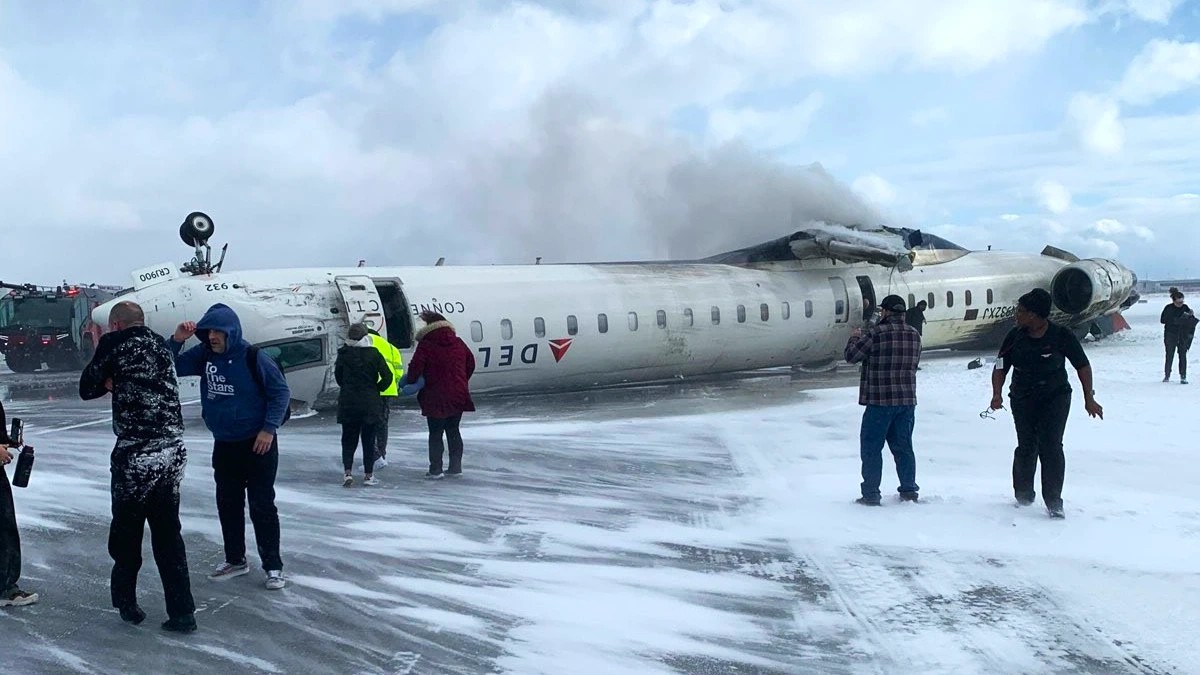
- Delta Connection Flight 4819 — a runway accident at Toronto’s Pearson Airport saw structural damage and injuries, showcasing how even nonfatal crashes can carry heavy operational and emotional costs.
And in late December, Harmony Jets Flight 185 — a private charter — crashed shortly after takeoff in Turkey, killing all onboard.
Why So Much Attention?
To how many plane crashes in 2025 crashes may look alarming. But there’s an important nuance: aviation accidents are not the same as commercial airline disasters, and not all accidents are equal in scale or consequence.
- General aviation (single-engine planes, private charters) historically sees far more incidents than scheduled airline flights.
- Commercial aviation remains overwhelmingly safe: data repeatedly show that fatal accidents involving major airlines are rare, and per-flight risk is minuscule compared to everyday activities like driving. Aviation authorities like the International Air Transport Association (IATA) regularly publish safety reports underscoring this trend.
Yet when a crash involves a large passenger aircraft or many fatalities — as we saw in the U.S. and Honduras — it captures global attention in a way that statistical safety records often do not.
The Broader Atmosphere: Trust, Fear, and the Culture of Flying
For decades, flying has been branded not just as a mode of transport but as a symbol of modern freedom — connecting distant families, economies, and cultures. It’s why disruptions in air travel resonate emotionally far beyond their statistical weight.
Psychologists studying risk perception note that rarefied, dramatic events like plane crashes loom larger in public consciousness than common but less sensational risks such as car accidents. The human brain prioritizes narrative over probability — a phenomenon well documented in behavioral economics. (Kahneman & Tversky, Prospect Theory). This explains why a rare high-fatality crash can shift public sentiment disproportionately compared with data-driven safety profiles.
Experts Weigh In: Safety Trends and the Future of Flight
To bring this into sharper perspective, we spoke with Dr. Elena Martinez, an aviation safety analyst at a major international research institute. Our conversation took place in a quiet office overlooking a bustling airport runway — a symbolic backdrop for a discussion about risk, resilience, and perception.
Q: How should we interpret 2025’s accident figures?
Dr. Martinez: “It’s important to see both the forest and the trees. Yes, 2025 saw several high-impact accidents, but that doesn’t reverse decades of safety improvements. The key metric is often the rate — fatalities per flight hour — not just raw counts.”
Q: Are we seeing a trend toward more crashes?
“Not in the strict statistical sense. Aviation’s long-term trend is downward. What can change year to year is the randomness of rare, high-impact events.”
Q: What’s the biggest misconception the public has about flying safety?
“Many people equate ‘rare’ with ‘impossible.’ Any complex system — like global aviation — will have failures. Our focus should be on systemic learning after each incident.”
This grounded perspective underscores a truth we revisit throughout the feature: fear may flare, but safety systems evolve.
FAQ: Understanding Plane Crashes in 2025
1. So, how many plane crashes were there in 2025?
There were roughly 150–200 reported aviation accidents globally across all categories, including general aviation, private, cargo, and commercial flights. A smaller subset — perhaps 15–20 — involved fatal outcomes.
2. Did 2025 have more crashes than normal?
In terms of fatalities and high-profile accidents, some metrics indicate an increase over 2024 — but not enough to suggest a reversal of long-term safety trends.
3. Is flying less safe now than before?
No. When measured per flight, aviation remains one of the safest forms of transportation. Rare high-fatality accidents don’t reflect an overall safety decline.
4. Why do plane crashes get so much attention?
Because they involve dramatic, rare events with many lives at stake — and they trigger deep psychological responses to risk.
5. What happens after a crash?
Investigative bodies like the NTSB and international counterparts meticulously review accidents to issue safety recommendations aimed at preventing similar tragedies.
Conclusion: Elevated Risks, Enduring Confidence
How many plane crashes in 2025 is not just a statistic. It’s a mirror reflecting how we process risk, fear, and trust in systems much larger than ourselves.
2025 tested that trust. It presented moments of tragedy, shock, and sorrow. But what the data also show — and what experts reiterate — is that those moments are outliers in a long arc of progress. Each accident becomes a learning point, not a pivot away from safety but a testament to the industry’s relentless commitment to improvement.
Read more: Amazon Stock Split: History, Strategy, and Why It Still Matters Today