









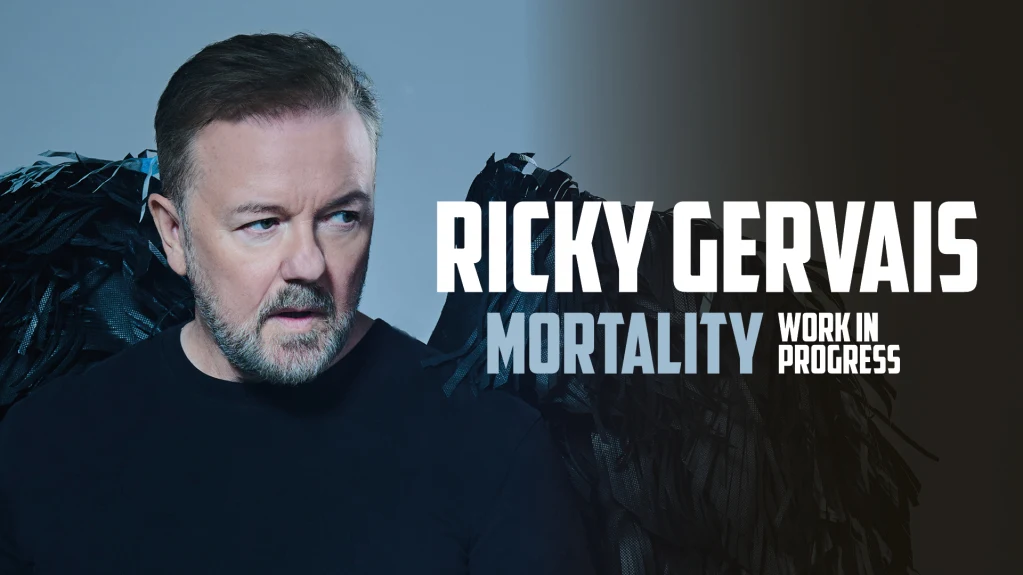
ricky gervais tour begins not with a punchline, but with a low hum of anticipation—the sound of thousands of people settling into red velvet seats, clutching drinks, checking phones, wondering how far he’ll go this time.
The lights dim. A single spotlight snaps on. Ricky Gervais walks out with no flourish, no hype video, no musical cue. Just a man, a mic, and the quiet confidence of someone who knows that silence is as powerful as noise. The audience laughs before he speaks—not because of a joke, but because they already understand the contract they’ve entered into. For the next two hours, comfort will be challenged, hypocrisy exposed, and laughter extracted from places polite society prefers not to look.
The Long Road to the Stage Again
Gervais did not arrive at this tour as a nostalgic victory lap. The Ricky Gervais tour exists at the intersection of endurance and provocation, shaped by decades of creative risk-taking. Before the sold-out arenas and international dates, there was a failed pop career in the 1980s, obscurity, and a late-blooming creative awakening that eventually produced The Office—a show that rewired modern comedy and workplace satire (ricky gervais tour).
Stand-up, however, has always been his most unfiltered medium. Unlike television, it offers no buffer—no character to hide behind, no editing room to soften the blow. As a form, stand-up comedy has historically thrived on boundary-pushing voices, from Lenny Bruce to George Carlin, performers who treated the stage as a testing ground for cultural limits (ricky gervais).
The Ricky Gervais tour is part of that lineage—but also a reaction to something newer: a cultural moment hyper-aware of language, power, and offense.
A Tour Shaped by a Fractured Culture
What makes the Ricky Gervais tour resonate now is not simply the jokes themselves, but the environment in which they land. These performances unfold in an era defined by social media outrage cycles, public call-outs, and algorithmic moralism. Gervais doesn’t deny this reality; he weaponizes it.
He talks openly about being “cancelled” in theory but not in practice. About tweeting into storms and walking away untouched. The laughs come not just from shock, but from recognition—the uneasy acknowledgment that many people share these thoughts privately but rarely voice them publicly.
This tension has followed Gervais for years. His Golden Globes monologues—eviscerating Hollywood hypocrisy in front of its most powerful figures—cemented his reputation as a cultural disruptor, praised by some as truth-telling and criticized by others as cruelty disguised as comedy. British press coverage has long framed him as a comedian willing to “say the unsayable,” a role he neither fully embraces nor rejects (ricky gervais tour).
The tour doesn’t ask the audience to agree with him. It asks them to listen—and then decide what laughter means in a world where words are increasingly policed.
The Shape of the Night
Structurally, a Ricky Gervais tour show feels deceptively loose. He paces. He pauses. He doubles back on earlier jokes, recontextualizing them after the audience has already reacted. This looping structure mirrors how real conversations about taboo topics unfold—messy, contradictory, unresolved.
There are themes that recur:
- The difference between intent and impact
- The absurdity of online virtue signaling
- Death, atheism, and the limits of empathy
- Fame as both shield and target
Unlike many comedians, Gervais rarely relies on observational humor about everyday life. His comedy is philosophical in disguise—using shock as an entry point into questions about morality, freedom of expression, and personal responsibility.
Audience as Co-Conspirator
To attend the Ricky Gervais tour is to join a temporary community defined by complicity. Laughter becomes a signal—not just of amusement, but of shared tolerance for discomfort. Some laughs are loud and immediate. Others arrive late, nervous, as if seeking permission.
The audience is strikingly diverse: longtime fans who followed him from Extras and After Life, younger viewers who discovered him through viral clips, skeptics curious to see what the controversy is about. His Netflix specials and HBO collaborations expanded this reach globally, transforming British irony into an international dialect of comedy (ricky gervais tour).
What binds them is not ideology, but curiosity. The desire to see how far comedy can stretch without snapping.
When Comedy Becomes a Mirror
Gervais often insists that jokes are not endorsements—that comedy describes reality rather than prescribing behavior. This idea runs through the tour like a thesis statement. He pokes at sacred cows not to destroy them, but to see why they’re sacred in the first place.
This philosophy echoes through his dramatic work as well. After Life, his Netflix series about grief and meaning, revealed a softer, more vulnerable side of his worldview, reminding audiences that the man delivering ruthless punchlines is also deeply preoccupied with mortality and kindness (ricky gervais tour).
The tour benefits from this duality. The cruelty feels less hollow when paired with moments of sincerity—when he admits uncertainty, or lingers on a silence just long enough for the laughter to fade into thought.
A Brief Comparative Glance
Globally, few comedians operate at Gervais’s scale while maintaining such a confrontational tone. American peers often soften edges to preserve sponsorships or platform access. European comics, meanwhile, tend to stay closer to political satire than moral provocation.
The Ricky Gervais tour occupies a rare middle ground: commercially massive yet ideologically stubborn. It reflects a uniquely British tradition of satire—dry, defiant, skeptical of authority—translated for a global audience increasingly unsure of what laughter is allowed to sound like.
Questions People Quietly Ask
Is the Ricky Gervais tour the same every night?
No. While there is a core structure, Gervais frequently adjusts pacing, emphasis, and audience interaction based on location and response.
Why does his comedy provoke such strong reactions?
Because it targets ideas many people tie closely to identity and morality, forcing emotional rather than purely intellectual reactions.
Is the tour meant to offend?
Offense is a byproduct, not the goal. The primary aim is interrogation—of beliefs, language, and assumptions.
Does he care about criticism?
Publicly, he treats it as material. Privately, by his own admission, he thinks about it more than he lets on.
The Meaning That Lingers
When the show ends, there’s no encore. No sentimental farewell. Just applause, some standing, some hesitant. People file out into the night carrying different reactions—exhilaration, discomfort, relief, irritation. All of them valid.