










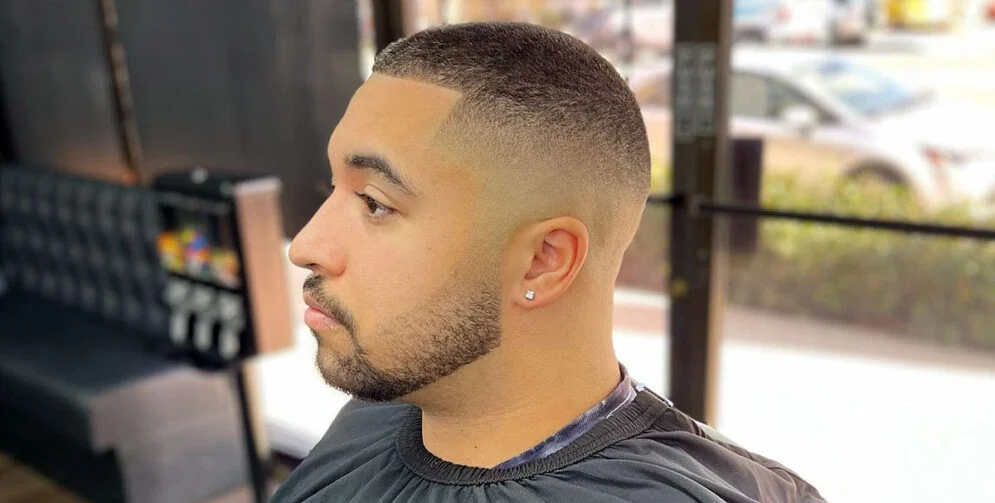
Buzz cut—the word lands with a vibration, a faint electric hum you can almost hear. It’s the sound of metal teeth passing over skin, the smell of warm hair and antiseptic, the moment when a mirror becomes an argument with yourself. The buzz cut arrives fast and leaves nothing to hide behind. It is hair reduced to intention.
In locker rooms and bathrooms, on military bases and fashion runways, the buzz cut has always been more than a haircut. It is a decision made under pressure or clarity, sometimes both. A declaration. A surrender. A reset.
Where the Buzz Began
The buzz cut did not begin as a trend; it emerged as a solution. In the early twentieth century, as modern armies industrialized, short hair became a matter of hygiene and uniformity. Lice spread quickly in trenches, and long hair slowed medical treatment. The solution was blunt and efficient: cut it all down. The style would later be codified in military grooming standards, particularly during World War II, when millions of young men encountered the buzz cut as their first enforced aesthetic choice.
( buzz cut)
From there, the cut escaped its original purpose. Like many utilitarian designs—denim jeans, work boots, trench coats—it moved outward, picked up meaning, and never quite lost its edge.
Stripping Time Down to Skin
A buzz cut does something unusual: it collapses time. Childhood photos resurface. You look younger and older at once. Without styling or silhouette, the face becomes the event. Ears, scars, asymmetries—features usually edited by hair—step forward.
Anthropologists have long noted that hair functions as social signaling: status, gender, rebellion, belonging. Removing it scrambles the signal. The buzz cut flattens class markers. It rejects ornament. In this way, it aligns with the philosophy of minimalism, a movement that privileges reduction as clarity rather than loss .
The buzz cut doesn’t whisper taste. It states presence.
Rebellion, Reinvention, and the Shock Moment
In the late twentieth century, the buzz cut found a new audience in subcultures that prized defiance. Punk scenes in London and New York adopted shaved heads not as conformity, but confrontation. The cut became a visual refusal of polished norms, a refusal documented in the history of punk subculture (buzz cut).
Pop culture amplified the shock value. When Britney Spears shaved her head in 2007, the act was treated less as grooming than spectacle—a public unraveling framed through tabloids rather than empathy (buzz cut). In hindsight, the moment reads differently: a woman seizing control of her body in a system determined to consume it.
Hair grows back. Meaning doesn’t always.
The Modern Return
Today’s buzz cut lives in contradiction. It appears on fashion runways in Paris, in Silicon Valley boardrooms, in TikTok transition videos where long hair falls away to reveal a newly sharpened self. It is genderless and hyper-gendered at the same time. On women, it still reads as radical; on men, it oscillates between default and statement.
During the COVID-19 lockdowns, millions picked up clippers at home, turning bathrooms into makeshift barbershops. The buzz cut surged again, less as style than survival. Salons were closed; control felt scarce. Cutting your own hair became a private ritual of agency amid uncertainty—a small act against a global pause documented in discussions around the COVID-19 pandemic (buzz cut).
Forms Within the Formless
Though it appears singular, the buzz cut has variations that subtly change its message:
| Style Variation | Description | Cultural Read |
|---|---|---|
| Induction Cut | Uniform length all over | Military, ascetic |
| Burr Cut | Slightly longer, soft texture | Practical, neutral |
| High & Tight | Short sides, minimal top | Discipline, authority |
| Dyed Buzz | Bleached or colored scalp | Artistic, defiant |
These distinctions matter to those who wear them. A few millimeters can shift perception from severe to intentional.
A Conversation in a Quiet Barbershop
I spoke with a veteran barber on a rainy afternoon, the shop nearly empty, clippers charging softly on the counter. The walls were lined with black-and-white photos: boxers, soldiers, musicians—all cropped close.
Q: Why do people still choose the buzz cut?
A: Because it’s honest. You can’t fake it. People come in when they want to start over or stop pretending.
Q: Is it usually planned?
A: Half the time. The other half, something just happened in their life. Breakup. New job. Loss. They don’t always say it, but you can feel it.
Q: Does it suit everyone?
A: Everyone has a head. That’s enough.
Q: What surprises clients most?
A: How calm they feel afterward. Like the noise got turned down.
Living With Less Hair
There is a practical side to the buzz cut that often gets overshadowed by symbolism. No styling routines. No product aisles. Less water, less time, fewer decisions. In an economy of attention stretched thin, that simplicity carries real appeal. Dermatologists often note improved scalp health with shorter hair, though sun protection becomes essential.
But the deeper experience is psychological. Studies in social psychology suggest that altering appearance during life transitions can reinforce identity change. Hair, being both intimate and public, is a powerful lever. The buzz cut pulls it all the way.
Frequently Asked Questions
Is a buzz cut considered professional today?
In many industries, yes. Creative fields and tech spaces have largely normalized it, while more traditional sectors vary by culture and region.
Does a buzz cut change how people treat you?
Often. Some report increased authority; others encounter bias. The reaction says as much about the observer as the cut.
How often does it need maintenance?
Typically every 2–4 weeks, depending on desired length and growth rate.
Is it a good choice during major life changes?
Many people choose it precisely for that reason—its clarity can mirror internal shifts.
What the Buzz Leaves Behind
The buzz cut endures because it refuses to settle into one meaning. It can be grief or freedom, discipline or defiance, anonymity or exposure. It asks a simple question—Who are you without adornment?—and doesn’t wait politely for the answer.
Read more: How Many Plane Crashes in 2025: A Year in the Sky That Tested Our Trust