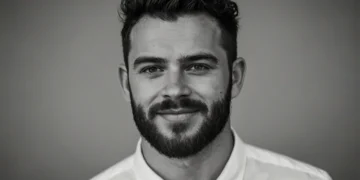










christopher briney first appears the way certain summers do—without announcement, already warm, already loaded with the feeling that something is about to change. It is evening on a beach that feels more remembered than real, salt still clinging to the air, and a young man stands at the edge of a story that millions already recognize as their own. He does not arrive as spectacle. He arrives as presence. The camera lingers, the tide breathes in and out, and a face—open, careful, withholding—becomes the emotional weather of the scene.
This is how Briney entered the cultural bloodstream: not as a star engineered by volume, but as an actor whose stillness invited projection. In an era of algorithmic fame, he feels almost analog—grainy, slow-burning, attentive to silence. His ascent says as much about the moment we are in as it does about the man himself.
Origins, Before the Tide Turned
Briney’s story begins far from the fictional beach houses that would later define his public image. Born in 1998 and raised in Connecticut, he grew up in a region where seasons mark time with insistence—winters that demand interiority, summers that briefly open the world. That rhythm matters. You can feel it in his performances: the sense of someone accustomed to waiting.
He studied acting at New York University’s Tisch School of the Arts, an institution known for balancing technique with risk, tradition with experimentation. Tisch has produced actors who understand that restraint can be as radical as excess, a lineage Briney quietly extends christopher briney. During those years, he worked in short films and student projects, learning the unglamorous craft of repetition—missed cues, bad lighting, scenes that fail and must be rebuilt.
The biography details are public and sparse—documented most clearly on his christopher briney what matters more is the shape of the preparation. Briney did not arrive famous. He arrived trained.
The Role That Reframed a Generation
If Briney’s early work formed the muscle, The Summer I Turned Pretty provided the pulse. Adapted from Jenny Han’s novels, the Amazon Studios series became a generational touchstone almost overnight, part of a lineage of teen dramas that stretches from The O.C. to Euphoria—stories where desire and identity are tested in public.
Briney’s Conrad Fisher is not written as an obvious heartthrob. He is guarded, occasionally abrasive, often silent when the genre expects speech. That silence became the character’s signature—and Briney’s calling card. Viewers argued online about Conrad with an intensity usually reserved for real people, not fictional boys on fictional beaches. TikTok edits slowed his glances to half-speed; Reddit threads parsed the ethics of his emotional withdrawal.
The series itself, contextualized christopher briney, sits at the intersection of nostalgia and modern vulnerability. Briney’s performance anchors that tension. He plays grief not as a monologue but as a posture—shoulders slightly forward, eyes always tracking an exit.
Cultural Meaning: Why the Quiet Ones Are Loud Now
There is a reason Briney resonates now. Contemporary youth culture, saturated with constant self-expression, has developed an appetite for characters who withhold. Conrad Fisher’s appeal lies in his refusal to explain himself fully—a mirror for a generation navigating mental health discourse while still craving mystery.
Briney’s work taps into a broader cultural recalibration. Masculinity on screen has softened, fractured, and diversified. Where earlier eras prized dominance or charm, this moment allows space for uncertainty. Briney embodies that shift. He does not perform confidence; he negotiates it.
This is not accidental. Streaming platforms like Amazon Studios have reshaped not just distribution but tone, privileging long-form emotional arcs over episodic resolution christopher briney. Briney’s Conrad benefits from that patience. So does the audience.
Craft in Motion: How Briney Works
During a quiet afternoon conversation in a borrowed rehearsal studio in Brooklyn—sunlight leaking through industrial windows—I spoke with a veteran casting director who has observed Briney’s rise from a professional distance.
Q: What distinguishes Christopher Briney in auditions?
A: “He listens. A lot of actors are busy showing you what they can do. Chris waits. He reacts. That’s harder than it sounds.”
Q: Is that teachable?
A: “Technique is teachable. Presence isn’t. He has a sense of interior life—you feel there’s something happening even when he’s still.”
Q: How does that translate on set?
A: “Directors trust him with silence. That’s rare, especially with young actors.”
Q: Does fame change that?
A: “It can. The question is whether he protects the quiet.”
The room fell silent after that last line, as if to demonstrate the point.
Beyond Conrad: Range and Risk
While The Summer I Turned Pretty remains his most visible work, Briney has begun to stretch outward. His appearance in the musical adaptation Mean Girls (2024) signaled a willingness to disrupt his own image—stepping into a pop-cultural machine with self-awareness and restraint.
A brief look at his emerging filmography shows intention rather than saturation:
| Year | Project | Medium | Note |
|---|---|---|---|
| 2022– | The Summer I Turned Pretty | TV Series | Breakthrough role |
| 2023 | Dalíland | Film | Supporting, art-world milieu |
| 2024 | Mean Girls | Film | Genre pivot |
This is not the résumé of an actor chasing ubiquity. It reads like someone choosing tension over comfort.
Audience, Fandom, and the Digital Echo
Briney’s fandom lives largely online, where interpretation becomes participation. Social platforms turn his pauses into canvases—GIFs, edits, essays disguised as comments. This is fandom as close reading, reminiscent of literary communities rather than celebrity worship.
The phenomenon recalls earlier moments when actors became symbols less of aspiration than recognition—think of the way certain indie performers of the 2000s were adopted as emotional proxies. Briney’s difference is timing. His rise occurs in a digital ecosystem that archives everything, freezes moments, loops them endlessly. Silence, under those conditions, becomes radical.
Comparative Glance: A Familiar, Different Lineage
It is tempting to compare Briney to actors like Timothée Chalamet, another Tisch alumnus whose vulnerability redefined young stardom. The comparison holds only briefly. Where Chalamet externalizes intensity, Briney internalizes it. One burns; the other simmers. Both belong to a generation that understands that visibility is not the same as revelation.
FAQs
Is Christopher Briney classically trained?
Yes. He studied acting at NYU Tisch School of the Arts, grounding his work in formal technique.
Why is he best known as Conrad Fisher?
The role aligned perfectly with his strengths—restraint, emotional depth, and the ability to communicate without exposition.
Has he worked outside television?
Yes. Briney has appeared in films including Dalíland and Mean Girls, expanding his range.
Is his fame largely online-driven?
Digital platforms amplified his visibility, but the foundation of his recognition remains performance-based.
The Quiet Future
What lingers after watching Christopher Briney is not a line reading or a plot twist, but a feeling—of having been allowed to sit with something unresolved. In a culture addicted to answers, that is a gift.
Read more: Lindsay Clancy; The Quiet Catastrophe Behind a Name