













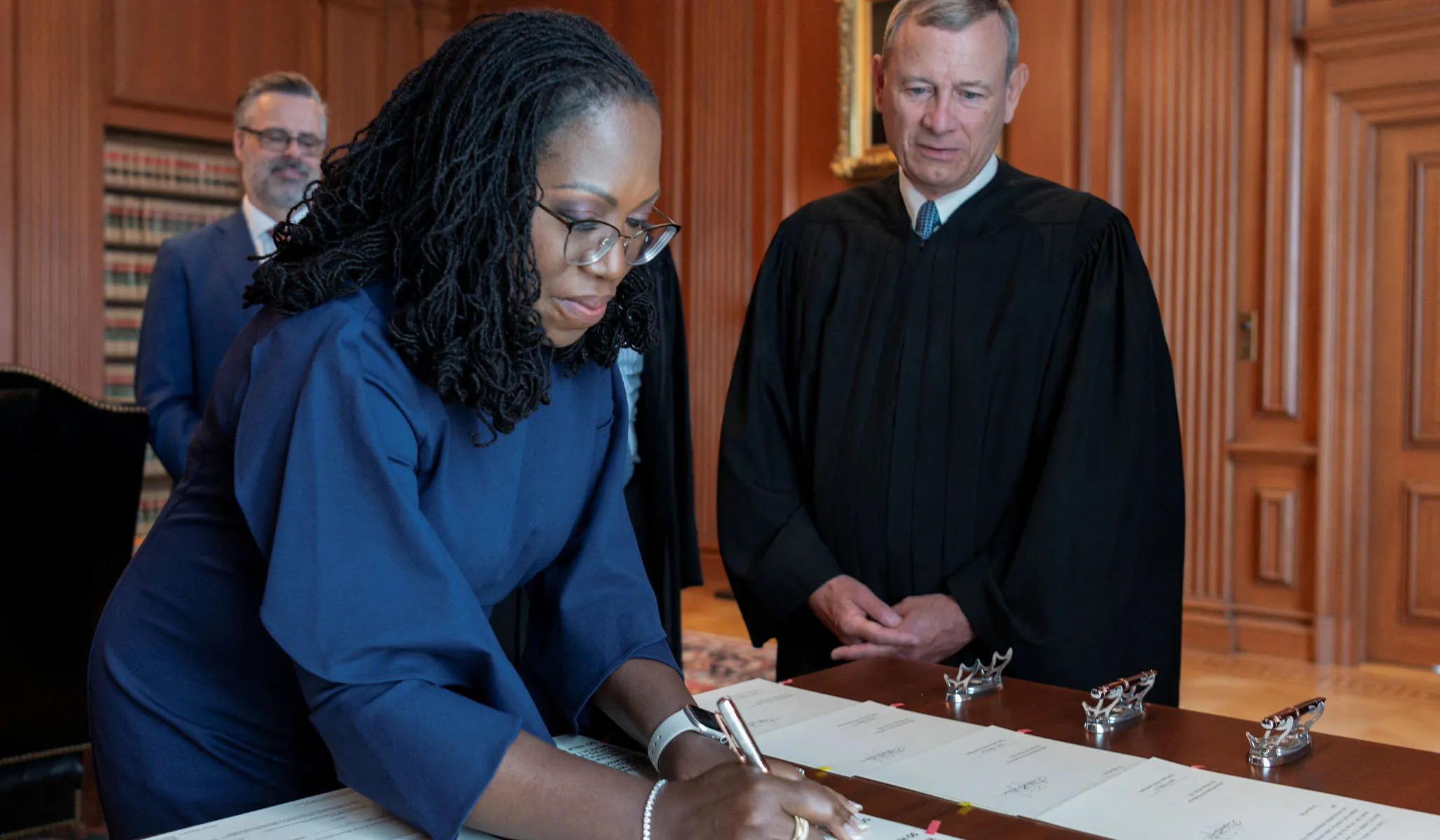
Justice Jackson Warns—the phrase surfaced not as a shout, but as a measured cadence inside a Supreme Court opinion, the kind that echoes long after the gavel has fallen. It arrived on a gray morning in Washington, D.C., when the marble steps of the Court were slick with rain and the city hummed with its usual mix of urgency and indifference. Inside, Justice Ketanji Brown Jackson leaned into the ancient ritual of dissent and concurrence, offering not merely a legal argument, but a warning—careful, restrained, and unmistakably human.
Her words did not plead for attention. They assumed it. Like many judicial warnings throughout history, they carried weight because they were issued calmly, by someone who understood that institutions rarely crumble in a single moment. They erode quietly, decision by decision, precedent by precedent.
The Roots of the Warning
To understand why Justice Jackson warns has become a phrase repeated across legal commentary and cultural analysis, one must first understand the arc of her arrival. Appointed in 2022, Justice Jackson became the first Black woman to sit on the Supreme Court—a milestone widely documented, including in her detailed biography on justice jackson warns. But symbolism alone does not explain the resonance of her voice.
Before ascending to the nation’s highest court, Jackson served as a federal public defender, a district judge, and a member of the U.S. Sentencing Commission. This trajectory—rare among Supreme Court justices—placed her in daily contact with the lived consequences of law, particularly on marginalized communities. Her warnings, therefore, are not abstract. They are grounded in experience.
The legal system she addresses is not merely theoretical; it is a mechanism that shapes lives, liberties, and futures. When she cautions against narrowing interpretations of constitutional protections, she does so with the memory of real defendants, real families, and real harm.
How the Warnings Took Shape Over Time
Early observers noted that Jackson’s opinions were meticulous, sometimes lengthy, and deeply contextual. Over time, however, a pattern emerged. Whether addressing voting rights, administrative authority, or criminal justice, Justice Jackson warns against a common danger: the slow normalization of legal shortcuts.
Her writing reflects an evolution not toward radicalism, but toward clarity. She increasingly frames her concerns in historical context, often invoking past Supreme Court errors—moments when the Court misread its own role, such as Plessy v. Ferguson, a case now widely studied as a cautionary tale on justice jackson warns.
These references are not rhetorical flourishes. They are reminders that the Court has been wrong before, sometimes disastrously so.
What the Warning Represents
At its core, Justice Jackson warns is less about a single case and more about institutional humility. Her opinions often emphasize that democracy depends on process, not outcomes; on restraint, not expediency.
Culturally, this warning resonates in an era when institutions—courts, media, even science—are under sustained pressure. Scholars at institutions like the Brookings Institution have noted that public trust in democratic systems is increasingly fragile. Jackson’s caution speaks directly to this moment, reminding readers that legitimacy is earned through consistency and fairness, not ideological victory.
Her voice carries a symbolic duality: she is both an insider to power and a witness to its limits.
Why It Matters Now
Modern relevance is unavoidable. The Supreme Court operates amid polarized politics, viral outrage, and instantaneous judgment. Legal decisions are dissected on social media before the ink has dried, often stripped of nuance.
Justice Jackson warns precisely against this flattening of complexity. She urges—implicitly and explicitly—that law cannot be practiced as performance. Her warnings are, in effect, reminders that constitutional interpretation is not content creation; it is stewardship.
This resonates far beyond legal circles. In classrooms, law schools, and civic forums, her opinions are now studied not just for what they decide, but for how they think. Institutions like the American Bar Association have highlighted the growing importance of judicial voices that explain, not merely rule.
The Setting: Inside the Supreme Court’s Quiet Tension
The Supreme Court is a paradoxical place—both public and cloistered. Tourists file through its halls while, behind closed doors, justices debate questions that will ripple across generations. Jackson’s warnings often emerge from this tension between visibility and secrecy.
Her writing style reflects the environment: formal yet accessible, restrained yet vivid. She frequently situates legal arguments within broader democratic values, acknowledging that the Court does not operate in a vacuum. This awareness of context sets her apart in an institution often criticized for insularity, as explored in analyses of the Court’s culture on justice jackson warns.
Interpretations and Public Reception
To some critics, Justice Jackson warns sounds like judicial activism. To others, it is judicial responsibility. This divergence itself is telling. Her warnings have become a mirror, reflecting the anxieties of a society unsure whether its institutions can still correct themselves.
Editorial boards, legal podcasts, and academic journals have parsed her language closely. What unites many interpretations is the sense that Jackson is speaking not just to her colleagues, but to history—to future readers who will ask how the Court responded when its authority was questioned.
A Conversation with a Constitutional Scholar
On a quiet afternoon in a Georgetown café, constitutional law professor Dr. Elaine Morris stirred her coffee thoughtfully as rain tapped against the windows.
Q: Why do Justice Jackson’s warnings feel different from traditional dissents?
A: “Because they’re not performative. She’s not writing for applause. She’s writing for the record.”
Q: Are these warnings aimed at the public or the Court itself?
A: “Primarily the Court. But she knows the public is listening. That dual awareness is powerful.”
Q: Do you see historical parallels?
A: “Absolutely. Think of Justice Harlan’s dissent in Plessy. At the time, it was lonely. Later, it was prophetic.”
Q: Will these warnings shape future jurisprudence?
A: “Even if they don’t immediately, they’ll shape how future justices understand this era.”
Frequently Asked Questions
Is “Justice Jackson warns” tied to one specific case?
No. It’s a phrase that has emerged from multiple opinions and dissents over time.
Is this warning political?
While interpretations vary, Jackson frames her concerns in legal and historical terms rather than partisan ones.
Why do her opinions receive so much attention?
Her background and writing style combine legal rigor with moral clarity.
Does this impact everyday citizens?
Indirectly, yes. Supreme Court interpretations shape rights, regulations, and public trust.
The Lasting Echo
In the end, Justice Jackson warns is not an alarm bell meant to incite panic. It is a lighthouse signal—steady, patient, and visible only to those willing to look. Her words remind us that democracy is not self-sustaining; it depends on vigilance, memory, and courage.
Read more: Karoline Leavitt Husband; The Man Beside the Microphone