






marco rubio wife is not a phrase that announces itself loudly in American politics. It enters the room softly—like the clink of porcelain in a kitchen before dawn, or the low hum of a car engine pulling out of a Miami driveway long before the sun rises. Yet behind those words lives a life that has shaped, steadied, and sometimes silently complicated one of the most visible conservative careers of the last two decades.
The story begins not on a debate stage or beneath television lights, but in the particular humidity of South Florida—where ambition, immigration, faith, and family are braided together as tightly as palm fronds in a coastal wind.
The Woman Behind the Senator
Jeanette Dousdebes Rubio has never campaigned for attention. Born in Miami to Colombian immigrants, her biography reflects a quieter American narrative—one grounded in service work, caregiving, and faith rather than spectacle. According to her publicly available profile, she studied at Miami Dade College and later worked as a community outreach coordinator for the Miami Dolphins, an experience that sharpened her sense of public service long before politics entered her life (marco rubio wife).
When she married Marco Rubio in 1998, he was not yet a senator, or a presidential contender, or a fixture of cable news. He was a young man with law school debt, political dreams, and a worldview shaped by exile stories from Cuba—a background well documented in his own biography (marco rubio wife).
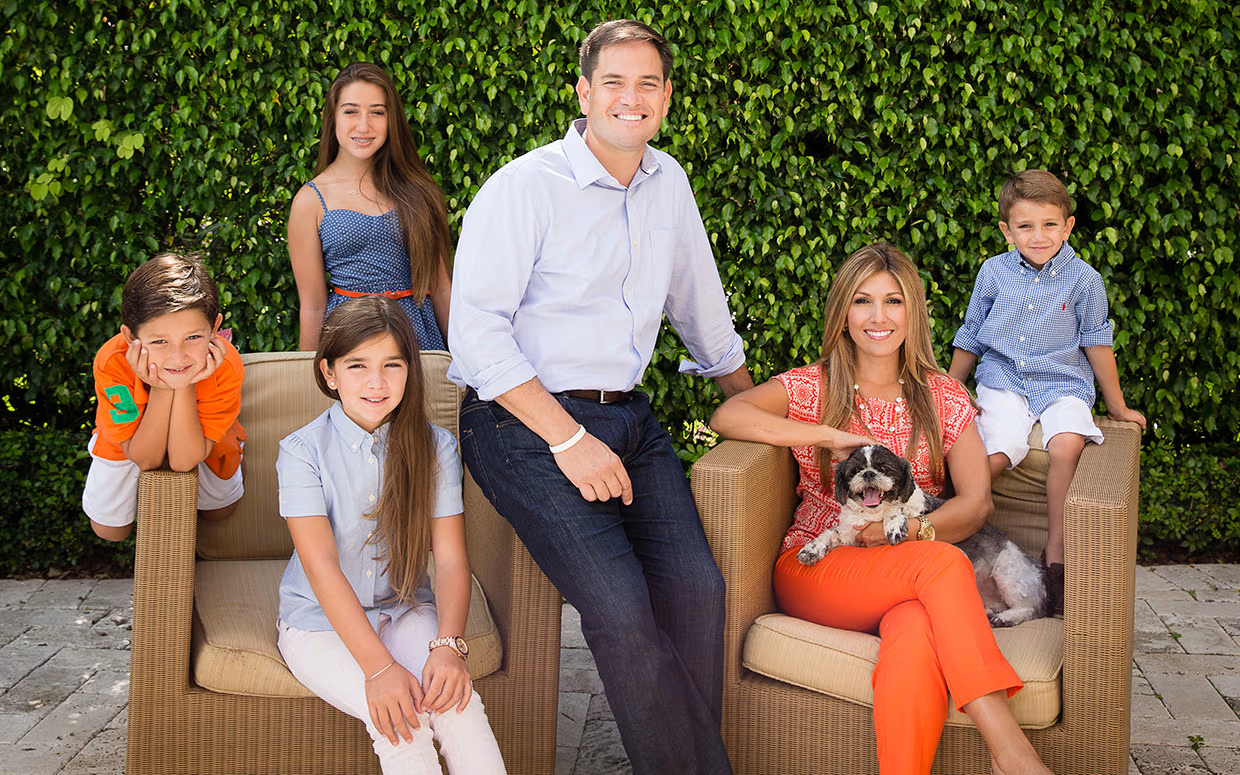
Jeanette’s role in that early chapter was not ornamental. Friends and colleagues have often described her as the emotional ballast of the Rubio household—raising four children while Marco navigated the precarious climb from local politics to national office.
A Marriage Shaped by Faith and Pressure
The Rubios’ marriage is deeply shaped by Catholicism, a faith both Jeanette and Marco returned to after earlier evangelical involvement. Religion here is not merely ideological; it is logistical and emotional. It determines school choices, social circles, and the moral vocabulary used to explain sacrifice to children whose father is often absent.
In Washington, political spouses are frequently expected to translate themselves into symbols—of charm, resilience, or ideological purity. Jeanette Rubio has largely resisted this conversion. During Marco Rubio’s 2016 presidential campaign, her rare public appearances stood out precisely because they felt unpolished: a woman visibly uncomfortable with spectacle, her pauses and hesitations conveying sincerity rather than strategy.
Political sociologists often note that such restraint can be a form of power. As researchers at the Pew Research Center have documented, religious and immigrant-family values continue to shape political identity among Latino Americans in ways that resist easy categorization (marco rubio wife).
Jeanette Rubio embodies that complexity—simultaneously traditional and modern, private and consequential.
Crisis as a Public Mirror
In 2011, Jeanette Rubio suffered a seizure and was later diagnosed with epilepsy. The disclosure—shared during Marco Rubio’s rise in national prominence—momentarily cracked the polished surface of political life. For once, the narrative was not about policy or polling, but vulnerability.
Health, particularly when it touches political families, has a way of revealing the scaffolding beneath public ambition. The diagnosis forced adjustments: driving restrictions, medication routines, and a recalibration of independence. Marco Rubio spoke openly about rearranging his Senate schedule to support his wife—an admission that subtly challenged conventional expectations of political masculinity.
Epilepsy advocacy organizations note that public acknowledgment from high-profile families can meaningfully reduce stigma, especially among communities where medical conditions are often kept private (marco rubio wife).
Jeanette Rubio never became a spokesperson, yet her visibility alone quietly expanded the conversation.
The Geography of a Political Marriage
The Rubio family has consistently chosen Miami over Washington as home—a decision that is both logistical and symbolic. Miami is not merely a backdrop; it is a living archive of exile, aspiration, and cultural layering. For Jeanette, remaining rooted there preserved a sense of normalcy for her children and continuity with extended family.
Urban historians often describe Miami as a city defined by “permanent arrival”—a place where immigrant identity is not transitional but foundational (marco rubio wife). Jeanette Rubio’s life unfolds within that framework, balancing the centrifugal pull of national politics with the gravitational force of home.
This geography matters. Political marriages fracture most often not under ideological disagreement, but under the strain of displacement. Jeanette’s insistence—quiet but firm—on anchoring family life in Florida may be among her most consequential decisions.
Public Silence as Strategy
Unlike many political spouses who cultivate platforms or advocacy portfolios, Jeanette Rubio has chosen selective silence. She does not maintain an independent public brand. She rarely grants interviews. When she does speak, it is typically in defense of family privacy rather than political principle.
Media scholars have argued that in an era of overexposure, privacy itself can function as a countercultural stance. By refusing constant visibility, Jeanette Rubio avoids becoming a proxy battlefield for partisan narratives—a fate that has befallen many spouses of national figures.
Her approach aligns with what feminist political theorists describe as “relational power”: influence exercised through stability, counsel, and emotional labor rather than public assertion.
Frequently Asked Questions
Who is Marco Rubio’s wife?
Marco Rubio is married to Jeanette Dousdebes Rubio, a Miami native of Colombian descent.
What does Jeanette Rubio do professionally?
She previously worked in community outreach and has focused primarily on raising their four children.
Does Jeanette Rubio appear publicly in political campaigns?
Only occasionally. She maintains a notably low public profile compared to many political spouses.
Has Jeanette Rubio spoken about her health condition?
Yes, her epilepsy diagnosis has been publicly acknowledged, though she does not campaign on health advocacy.
Where does the Rubio family live?
They reside primarily in Miami, Florida, rather than Washington, D.C.
The Unseen Architecture
In political mythology, power is often imagined as a solo ascent—a single figure climbing toward relevance. Real life is less cinematic, more architectural. It is built slowly, reinforced quietly, maintained daily.
The story of marco rubio wife is not one of speeches or slogans. It is a story of continuity in a culture obsessed with rupture, of restraint in an ecosystem that rewards noise. Jeanette Rubio’s influence is not measured in policy wins or polling bumps, but in endurance: the capacity of a family to remain intact under relentless public scrutiny.
Read more: David Corenswet Superman: The New Face of Hope in DC’s Future