














Introduction
If you searched for Droven IO AI automation tools, you are probably trying to understand how AI automation works and which tools are worth your time. Many business owners, startup founders, marketers, and developers face the same problem. There are hundreds of AI tools available, but most articles either promote a product or explain automation in a confusing way. Finding practical and trustworthy information before investing in AI software can be difficult.
After reviewing AI automation resources, comparing different automation platforms, and analyzing how businesses adopt AI, I noticed one common challenge. Most companies do not struggle because AI is too complicated—they struggle because they don’t know where to start. Learning the basics first makes it much easier to choose the right tools and build effective workflows. This guide explains AI automation in simple language, explores where it delivers real business value, and helps you understand which solutions are best suited for different business needs.
📌 Droven IO AI Automation Tools at a Glance
| Category | Details |
|---|---|
| Search Intent | Learn AI automation and workflow optimization. |
| Best For | Small businesses, startups, marketers, developers, students. |
| Main Benefit | Reduce repetitive work and improve productivity. |
| Popular Tools | ChatGPT, Zapier, Make, n8n, UiPath, Claude, Gemini. |
| Learning Goal | Understand AI automation before choosing software. |
The term Droven IO AI automation tools is commonly searched by people who want to learn about artificial intelligence, workflow automation, and business productivity. Many users expect Droven IO to be an AI automation platform, while others search for it to understand how AI can improve daily business operations.
AI automation combines artificial intelligence with workflow automation to reduce repetitive work. Instead of completing the same tasks manually, businesses use AI-powered tools to automate processes, analyze information, generate content, and connect multiple applications. This helps teams save time, improve accuracy, and focus on higher-value work.
Whether you run a small business, manage a growing startup, work in marketing, or simply want to understand AI automation, learning how these tools work can help you make smarter technology decisions.
Key Takeaways
- AI automation reduces repetitive manual work.
- Businesses use AI to improve productivity and save time.
- Modern automation platforms connect multiple applications into one workflow.
- Different AI automation tools serve different business needs.
- Choosing the right platform depends on your goals, budget, and technical experience.
Why Businesses Use AI Automation
🚀 AI Automation Adoption Journey
Most businesses follow a similar path when adopting AI automation.
Every business performs repetitive tasks. Employees send emails, update spreadsheets, schedule meetings, create reports, manage customer information, and answer common questions every day. These activities consume valuable time that could be spent on more important work.
AI automation helps businesses complete these tasks faster and with fewer errors. Instead of replacing employees, automation supports them by handling routine work.
Some of the biggest benefits include:
- Faster workflow execution
- Better accuracy
- Lower operating costs
- Improved customer experience
- Higher team productivity
- Better decision-making using AI-generated insights
- Reduced manual errors
- Faster response times
Businesses of all sizes now invest in AI automation because it improves efficiency without increasing operational complexity.
Who Should Learn About AI Automation?
🤔 Is AI Automation Right for You?
Use this quick guide to see if AI automation matches your current needs.
| If You… | AI Automation Can Help |
|---|---|
| Repeat the same tasks every day | ✅ Yes |
| Copy data between apps manually | ✅ Yes |
| Manage customer emails manually | ✅ Yes |
| Need faster reporting | ✅ Yes |
| Already have efficient automated workflows | ⚠ Review before adding more automation |
The topic Droven IO AI automation tools is valuable for many different users. Although each audience has different goals, they all want to improve productivity and reduce repetitive work.
Small Business Owners
Small business owners often manage multiple responsibilities with limited staff. AI automation can simplify everyday operations by automating customer emails, appointment scheduling, invoices, and follow-up messages.
Their main goals include:
- Saving time
- Reducing operating costs
- Improving customer service
- Growing the business efficiently
Startup Founders
Startups need to grow quickly while keeping expenses under control. AI automation allows founders to build efficient workflows without hiring large teams.
Automation can help with:
- Lead management
- Customer support
- Internal communication
- Report generation
- Marketing activities
This allows startup teams to focus on product development and business growth.
Operations Managers
Operations managers are responsible for improving business processes. They use AI automation to reduce bottlenecks, eliminate repetitive work, and connect different business systems into one workflow.
Automation also improves collaboration between departments and reduces delays caused by manual processes.
Digital Marketers
Marketing professionals use AI automation every day. It helps them create content ideas, schedule social media posts, automate email campaigns, qualify leads, and analyze campaign performance.
Instead of spending hours on repetitive marketing tasks, they can focus on strategy and creativity.
Developers and IT Professionals
Developers often build custom workflows by connecting APIs and automation platforms. AI automation tools help them automate repetitive technical tasks, monitor systems, and integrate business applications.
Open-source automation platforms are especially popular among technical teams because they offer greater flexibility and customization.
Students and Career Changers
Many beginners search for Droven IO AI automation tools because they want to understand AI before entering the technology industry. Learning workflow automation, AI concepts, and productivity tools helps them prepare for careers in business, marketing, software development, and operations.
Common Goals of AI Automation Users
Although every business has different requirements, most users share similar goals.
They want to:
- Reduce repetitive work
- Save time every day
- Improve team productivity
- Lower business costs
- Make faster business decisions
- Learn modern AI technologies
- Build scalable workflows
- Improve operational efficiency
Understanding these goals helps organizations choose automation tools that match their real business needs.
AI Automation vs Traditional Automation
Both approaches automate work, but they operate differently.
⚖️ AI Automation vs Traditional Automation
Although both AI automation and traditional automation improve efficiency, they work differently. Understanding these differences helps businesses choose the right approach for their workflows.
| AI Automation | Traditional Automation |
|---|---|
| 🧠 Uses artificial intelligence to support decisions | ⚙️ Follows fixed rules only |
| 📊 Learns from data patterns | 🔁 Repeats predefined actions |
| 🔄 Can adapt to changing information | 📋 Works best with predictable processes |
| 📈 Supports predictive insights | ❌ Cannot analyze complex data |
| 🚀 Handles more advanced workflows | ✅ Best for repetitive tasks |
Traditional automation is ideal for repetitive, rule-based tasks, while AI automation adds intelligence by analyzing data, adapting to changing conditions, and supporting better decision-making. Many businesses combine both approaches to build smarter and more efficient workflows.
Many organizations combine both approaches to create faster and more reliable business workflows.
Core Features of AI Automation Tools
Modern AI automation platforms include several features that help businesses automate daily work more efficiently.
AI Workflow Builder
Workflow builders allow users to create automated processes without writing complex code. Most platforms provide drag-and-drop interfaces where users connect triggers, actions, and conditions into one automated workflow.
For example, when a customer completes a contact form, the workflow can automatically:
- Send a confirmation email
- Update the CRM
- Notify the sales team
- Create a follow-up task
Everything happens automatically without manual effort.
AI Assistants and AI Agents
AI assistants answer questions, summarize documents, generate content, and support everyday business activities.
More advanced AI agents can plan tasks, make decisions based on instructions, and complete multiple steps within a workflow while requiring very little human involvement.
These capabilities help businesses reduce repetitive work and improve response times.
API and Application Integration
Most AI automation platforms connect with business applications through APIs.
These integrations allow information to move automatically between different systems.
Common integrations include:
- CRM software
- Email platforms
- Project management tools
- Cloud storage
- Accounting software
- Communication platforms
- Calendar applications
Connecting applications removes duplicate work and creates one connected workflow across the organization.
Machine Learning Capabilities
Some AI automation platforms use machine learning models to improve predictions and recommendations after they have been trained on business data.
These models help organizations identify patterns, forecast outcomes, and make more informed decisions.
Machine learning is especially useful for customer analytics, fraud detection, sales forecasting, and document classification.
How an AI Automation Workflow Works
Most AI automation workflows follow a simple sequence.
- A trigger starts the workflow.
- AI analyzes the incoming information.
- Business rules determine the next action.
- The system performs automated tasks.
- Connected applications receive updated information.
- Users receive notifications or reports.
For example, when a customer submits a support request, AI can identify the issue, assign the correct support agent, create a ticket, update the CRM, and send a confirmation email within seconds.
Common Business Challenges and AI Solutions
Many organizations lose valuable time because employees perform the same tasks every day. AI automation solves these problems by reducing manual work.
💼 Common Business Challenges and AI Automation Solutions
Many businesses lose valuable time because employees spend hours on repetitive tasks. AI automation helps eliminate these bottlenecks by reducing manual work, improving accuracy, and increasing overall productivity.
| Business Challenge | AI Automation Solution |
|---|---|
| 📝 Manual data entry | ⚡ Automated data synchronization |
| 🎧 Slow customer support | 🤖 AI chatbots and virtual assistants |
| 📧 Repetitive email responses | 📨 Automated email workflows |
| 📊 Delayed report generation | 📈 AI-powered reporting tools |
| 🎯 Lead management | 🔄 Automated CRM updates |
| 📂 Document processing | 🧠 Intelligent document automation |
Start by automating one repetitive task with the biggest impact, such as email management or data entry. Once you see measurable improvements, you can expand automation to other business processes.
These improvements allow employees to focus on strategic work instead of repetitive administrative tasks.
Popular AI Automation Tools
🛠 Which AI Automation Tool Fits Your Needs?
| If You Want To… | Recommended Tool |
|---|---|
| Write articles, emails, or content | ChatGPT |
| Build no-code workflows | Zapier |
| Create visual automations | Make |
| Self-host automation | n8n |
| Automate Microsoft apps | Power Automate |
| Enterprise automation | UiPath |
Many businesses combine educational resources with proven automation platforms to improve productivity.
Some of the most popular AI automation tools include:
🤖 Popular AI Automation Tools Comparison
Choosing the right AI automation tool depends on your business goals, technical expertise, and workflow requirements. The table below highlights some of the most popular platforms and their primary use cases.
| Tool | Best For |
|---|---|
| ChatGPT | Content creation and AI assistance |
| Claude | Document analysis and writing |
| Google Gemini | Research and productivity |
| Zapier | No-code workflow automation |
| Make | Visual workflow automation |
| n8n | Open-source automation |
| Microsoft Power Automate | Microsoft business workflows |
| UiPath | Enterprise robotic process automation |
Quick Tip: Beginners often start with ChatGPT and Zapier, while developers prefer n8n. Large organizations usually choose Microsoft Power Automate or UiPath for enterprise-level automation.
Each platform serves different business requirements. Before selecting one, compare its integrations, pricing, ease of use, scalability, and available AI features.
Which AI Automation Tool Should You Choose?
The right automation platform depends on your experience level and business goals.
🎯 Which AI Automation Tool Should You Choose?
Every business has different automation needs. The best platform depends on your technical skills, business size, and workflow requirements. Use this quick comparison to find the right tool for your situation.
| User Type | Recommended Tool |
|---|---|
| 👨🎓 Beginners | Zapier |
| 🏪 Small Businesses | Make |
| 💻 Developers | n8n |
| 🏢 Enterprise Organizations | UiPath |
| 🪟 Microsoft Users | Microsoft Power Automate |
| ✍️ Content Teams | ChatGPT or Claude |
If you’re just getting started, choose a simple no-code platform like Zapier or Make. Developers who need more flexibility often prefer n8n, while large organizations usually benefit from enterprise solutions such as UiPath or Microsoft Power Automate. Content creators can improve productivity with AI assistants like ChatGPT and Claude.
Instead of choosing the most popular platform, focus on the one that solves your biggest business challenges and supports your future growth.
Business Use Cases for AI Automation
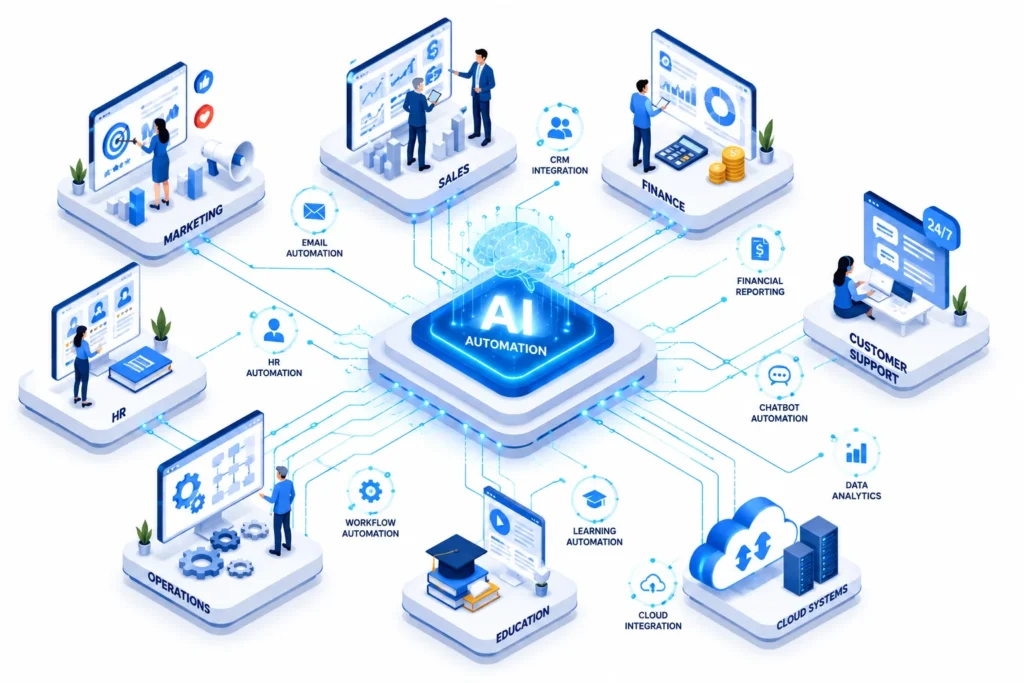
🏢 AI Automation Across Business Departments
| Department | Example Automation |
|---|---|
| Sales | Lead capture and follow-up emails |
| Marketing | Content creation and campaign automation |
| Human Resources | Resume screening and onboarding |
| Finance | Invoice processing and payment reminders |
| Customer Support | AI chatbots and ticket routing |
| Operations | Workflow approvals and reporting |
AI automation supports many industries because repetitive work exists in almost every business.
Marketing
Marketing teams use AI automation to generate content ideas, schedule social media posts, create personalized email campaigns, qualify leads, and analyze campaign performance.
Customer Support
AI chatbots answer common customer questions, route support tickets, and provide assistance around the clock. This improves response times and increases customer satisfaction.
Human Resources
HR teams automate resume screening, interview scheduling, employee onboarding, leave requests, and document management.
Sales
Sales departments automate lead capture, CRM updates, follow-up emails, pipeline tracking, and performance reporting. This allows sales teams to spend more time building customer relationships.
Finance
Finance departments use AI automation to process invoices, track expenses, send payment reminders, generate reports, and reduce manual accounting work.
Operations
Operations teams automate internal approvals, inventory updates, workflow monitoring, and business reporting. This helps improve efficiency across multiple departments while reducing delays caused by manual processes.
AI Automation Readiness Checklist
Before investing in any AI automation solution, evaluate your current business processes. This simple checklist can help you decide if your business is ready for automation.
Ask yourself these questions:
- Do you repeat the same tasks every day?
- Do you manually copy data between different applications?
- Do you spend hours replying to similar emails?
- Do you generate weekly or monthly reports manually?
- Do your employees perform repetitive administrative work?
- Do you want to improve productivity without hiring more staff?
If you answered “Yes” to most of these questions, AI automation could provide immediate value to your business.
How Businesses Choose the Right AI Automation Platform
Choosing the right automation platform requires more than comparing features. Businesses should evaluate solutions based on their current needs and future growth plans.
Consider the following factors before making a decision.
Ease of Use
A user-friendly platform helps teams start automation faster. No-code and low-code tools are ideal for beginners because they require little or no programming knowledge.
Integration Options
Choose a platform that connects with the software your business already uses, such as CRM systems, email platforms, accounting software, cloud storage, and project management tools.
Security and Data Protection
Automation platforms often process sensitive business information. Look for platforms that provide strong security features, user permissions, and data protection controls.
Scalability
Your automation needs will grow as your business grows. Select a solution that can handle more workflows, users, and integrations over time.
Customer Support
Reliable customer support and detailed documentation make it easier to solve technical issues and learn new features.
Pricing
Compare pricing plans carefully. Free plans are useful for testing workflows, while premium plans usually offer advanced automation features and higher usage limits.
Where AI Automation Delivers the Most Value
Many organizations begin automation in departments where repetitive work consumes the most time.
The most common departments include:
- Customer Support
- Sales
- Marketing
- Human Resources
- Finance
- Operations
- Project Management
Starting with one department allows businesses to measure results before expanding automation across the organization.
Common Challenges of AI Automation
Although AI automation offers many advantages, businesses should also understand its limitations.
Some common challenges include:
- Poor workflow planning
- Incorrect automation rules
- Integration compatibility issues
- Employee training requirements
- Data privacy concerns
- Ongoing workflow maintenance
- Monitoring automated processes
Planning workflows carefully before deployment helps reduce these challenges.
Common AI Automation Mistakes to Avoid
Successful automation depends on good planning. Avoid these common mistakes when building AI-powered workflows.
- Automating inefficient processes before improving them.
- Selecting software without checking integration support.
- Skipping workflow testing before deployment.
- Ignoring security and data privacy requirements.
- Depending entirely on AI without human review.
- Forgetting to monitor workflow performance.
- Automating too many processes at once.
Businesses usually achieve better results by starting with one workflow and gradually expanding automation.
📈 AI Automation Maturity Stages
| Stage | Business Focus | Primary Goal |
|---|---|---|
| 🟢 Beginner | Automate one task | Save time |
| 🟡 Growing | Connect multiple apps | Improve efficiency |
| 🟠 Advanced | AI agents & workflows | Scale operations |
| 🔵 Enterprise | Organization-wide automation | Digital transformation |
Best Practices for Successful AI Automation
Following proven best practices helps businesses improve automation performance and reduce unnecessary risks.
- Start by automating simple repetitive tasks.
- Test every workflow before using it in production.
- Monitor workflow performance regularly.
- Review automation results and improve them over time.
- Keep business data secure.
- Train employees on new workflows.
- Document every automation process.
- Update AI models and integrations when needed.
These practices help organizations maintain reliable and efficient workflows.
Future of AI Automation
AI automation continues to evolve as new technologies become available. Businesses are now moving beyond simple automation toward intelligent systems that can perform more complex work.
Some important trends include:
AI Agents
AI agents can complete multi-step tasks with minimal human involvement. They analyze information, make decisions based on instructions, and complete workflows automatically.
Hyperautomation
Hyperautomation combines artificial intelligence, robotic process automation (RPA), APIs, and business process automation into one connected system.
No-Code and Low-Code Automation
Modern platforms allow non-technical users to build workflows without writing complex code. This makes automation accessible to more businesses.
Intelligent Document Processing
AI can now read invoices, contracts, forms, and business documents. It extracts information automatically and reduces manual data entry.
Workflow Orchestration
Workflow orchestration connects multiple business systems into one automated process. Instead of automating individual tasks, organizations automate complete business operations across different departments.
As AI technology continues to improve, businesses will automate more complex processes while maintaining greater accuracy and efficiency.
Expert Insight
After reviewing today’s AI automation landscape, one thing becomes clear. Businesses achieve the best results when they begin with simple, repetitive tasks instead of trying to automate every process at once.
Successful companies usually start with one workflow, measure the results, and then expand automation step by step. This approach reduces risk, improves adoption, and delivers better long-term results.
Decision Stage of Most Readers
People searching for Droven IO AI automation tools are usually in the research stage of their buying journey.
Most readers want answers to questions like:
- What is AI automation?
- Which AI automation tool should I choose?
- Can automation improve my business?
- Which platform fits my budget?
- Is AI automation suitable for beginners?
- How can I automate repetitive tasks?
Providing clear answers to these questions helps businesses make informed technology decisions before investing in automation software.
💡 AI Automation Myths vs Reality
| Myth | Reality |
|---|---|
| AI replaces every employee. | AI supports people by automating repetitive work. |
| Automation is only for large companies. | Small businesses can benefit just as much. |
| You need coding skills. | Many platforms are no-code or low-code. |
| Every process should be automated. | Some tasks still require human review. |
Frequently Asked Questions
What are Droven IO AI automation tools?
The term generally refers to information related to AI automation, workflow optimization, and modern productivity technologies. People often search this keyword to learn how AI can improve business processes and automate repetitive work.
What is AI automation?
AI automation combines artificial intelligence with workflow automation to complete repetitive tasks with minimal human effort. It helps businesses improve productivity, reduce manual work, and increase operational efficiency.
Which industries benefit from AI automation?
Many industries benefit from AI automation, including healthcare, finance, retail, education, marketing, manufacturing, customer support, logistics, and human resources.
Are AI automation tools suitable for small businesses?
Yes. Many no-code and low-code automation platforms are designed for small businesses. They help automate routine tasks without requiring advanced technical skills.
What is the difference between AI automation and traditional automation?
Traditional automation follows predefined rules to perform repetitive tasks. AI automation goes further by analyzing data, recognizing patterns, generating insights, and supporting decision-making using artificial intelligence.
How do I choose the best AI automation tool?
Start by identifying your business challenges. Then compare platforms based on ease of use, integrations, pricing, scalability, security, customer support, and AI capabilities. Choose the solution that aligns with your business goals instead of simply selecting the most popular platform.
✅ Quick AI Automation Wins
If you’re new to AI automation, start with these simple tasks before moving to larger workflows.
- ✅ Automate email replies
- ✅ Capture website leads automatically
- ✅ Schedule social media posts
- ✅ Generate weekly reports
- ✅ Create invoices automatically
- ✅ Route customer support tickets
- ✅ Send appointment reminders
- ✅ Sync customer data between apps
Conclusion
After researching AI automation trends and comparing how businesses use automation tools, one thing stands out. Successful companies do not try to automate everything at once. Instead, they begin with simple, repetitive tasks like email responses, data entry, customer support, or reporting. Once those workflows prove successful, they gradually expand automation across other parts of the business. This step-by-step approach reduces risk and delivers better long-term results.
My biggest takeaway is that understanding AI automation is more valuable than simply following the latest technology trend. When you learn how automation works, compare different platforms carefully, and choose solutions based on your actual business needs, you make smarter decisions that support long-term growth. Whether you are a small business owner, a startup founder, a marketer, or someone learning about AI for the first time, building a strong foundation today will help you benefit from future advances in AI automation with greater confidence.
Explore More on The Write Posts: Discover expert guides on AI tools, workflow automation, productivity software, and emerging technologies to help you make smarter business decisions.