













Starting and running a small business is exciting, but it also comes with constant challenges. Every day, you’re making decisions that affect your company’s future. You’re serving customers, managing operations, handling finances, and trying to grow your business—all while competing with businesses that may have much larger marketing budgets.
Then comes the biggest challenge: getting found online.
You build a website, create social media accounts, and maybe even run a few online ads. Friends tell you to focus on SEO. Others recommend Facebook ads, email marketing, or TikTok. Before long, you’re investing time and money into different marketing activities without knowing which ones actually help your business grow.
This is a common situation for many small business owners.
The problem usually isn’t a lack of effort. It’s the lack of a clear marketing strategy. Digital marketing includes many moving parts, and it’s difficult to know where to invest your time and budget when you’re also running a business.
That’s where a digital marketing agency can help.
A good digital marketing agency doesn’t simply sell marketing services. It works as a strategic partner that helps you attract the right customers, improve your online visibility, generate qualified leads, and measure what is actually driving business growth. Instead of relying on guesswork, your marketing decisions are based on research, data, and long-term goals.
Why Digital Marketing Matters More Than Ever for Small Businesses
Today’s customers rarely make buying decisions without doing some research first.
Whether someone needs a plumber, a dentist, a restaurant, or an online store, they usually start with a search engine, online reviews, social media, or recommendations.
If your business doesn’t appear where your customers are looking, there’s a good chance they’ll choose a competitor instead.
This is why digital marketing has become essential rather than optional.
It helps your business:
- Reach people actively searching for your products or services.
- Build trust through useful content and customer reviews.
- Increase brand awareness.
- Generate qualified leads.
- Turn website visitors into paying customers.
- Measure what works and improve future marketing efforts.
Unlike traditional advertising, digital marketing provides measurable results. You can see where your traffic comes from, which campaigns generate leads, and how your marketing budget contributes to business growth.
What Is a Digital Marketing Agency?
A digital marketing agency is a team of professionals who help businesses promote their products or services through online channels.
Instead of hiring separate specialists for search engine optimization (SEO), paid advertising, website design, content writing, social media management, and analytics, you work with one team that brings these skills together.
Their role goes beyond completing individual marketing tasks.
A good agency develops a strategy that aligns every marketing activity with your business goals. That means each campaign, blog article, advertisement, and website improvement supports the same objective—helping your business grow.
For many small businesses, this approach saves time, reduces costly mistakes, and allows owners to focus on serving customers instead of trying to master every aspect of digital marketing.
Quick Answer: What Does a Digital Marketing Agency Do for Small Businesses?
If you’re looking for a simple answer, a digital marketing agency helps small businesses attract more customers, improve their online visibility, and increase sales through a combination of digital marketing strategies.
Instead of relying on a single marketing tactic, an agency combines services such as search engine optimization (SEO), local SEO, paid advertising, content marketing, social media management, website optimization, email marketing, and performance tracking. The goal is to create a strategy that helps your business reach the right audience, generate qualified leads, and support long-term growth.
Every business has different goals, so the best agencies focus on the marketing activities that are most likely to produce measurable results instead of applying the same strategy to every client.
Why add this?
Gives readers an immediate answer.
Improves Featured Snippet potential.
Helps AI Overviews.
What Does a Digital Marketing Agency Do for Small Businesses?
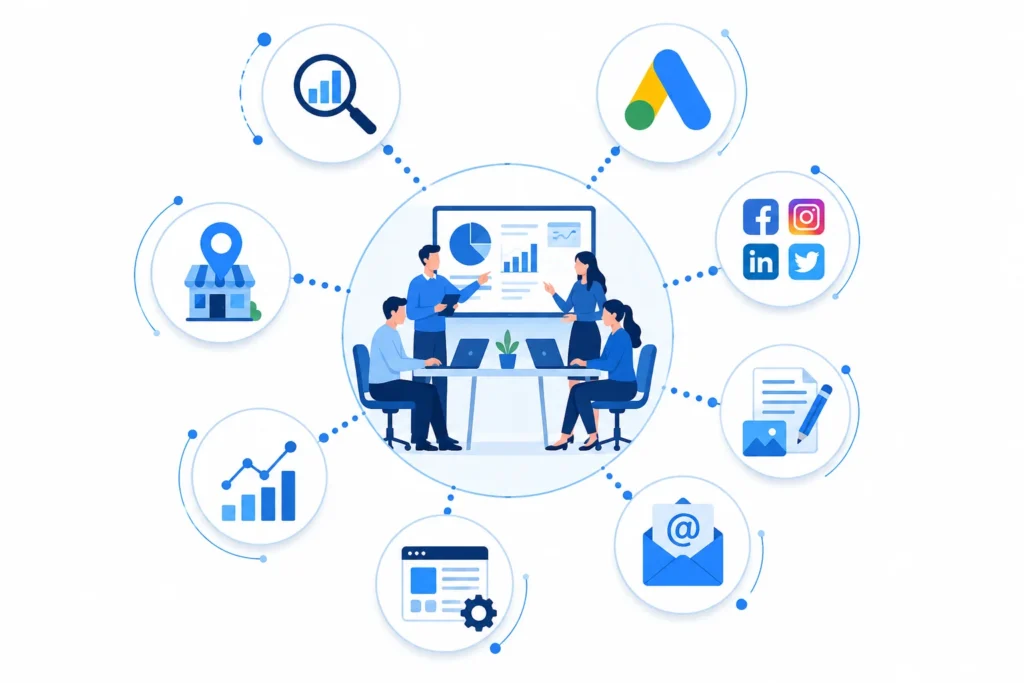
A digital marketing agency helps small businesses attract, convert, and retain customers through a combination of marketing strategies. Rather than relying on one tactic, it uses multiple digital channels that work together to achieve measurable results.
The exact services vary between agencies, but most provide the following.
Search Engine Optimization (SEO)
Search engine optimization helps your website appear in search results when people look for products or services related to your business.
For example, if someone searches for “best coffee shop near me” or “roof repair in Dallas,” your goal is to appear where potential customers can find you.
A digital marketing agency improves your chances by:
- Researching the keywords your audience searches for.
- Optimizing website pages.
- Improving page speed and mobile usability.
- Fixing technical SEO issues.
- Creating helpful content.
- Building your website’s authority.
- Monitoring search performance.
SEO takes time, but it often becomes one of the most valuable long-term marketing investments because it can generate consistent organic traffic without paying for every click.
Local SEO
If your business serves a specific city or region, local SEO is just as important as traditional SEO.
Many customers search for businesses using phrases like:
- “near me”
- “open now”
- “best dentist in Austin”
- “emergency plumber”
A digital marketing agency helps improve your visibility by optimizing your Google Business Profile, managing business listings, encouraging customer reviews, and ensuring your business information is accurate across online directories.
For many local businesses, these improvements can increase phone calls, website visits, and store traffic.
Pay-Per-Click (PPC) Advertising
SEO builds long-term visibility, but sometimes businesses need results more quickly.
This is where PPC advertising helps.
Platforms like Google Ads allow your business to appear at the top of search results almost immediately.
An agency manages every part of the campaign, including:
- Keyword research
- Audience targeting
- Ad creation
- Budget management
- Landing page optimization
- Conversion tracking
Instead of simply increasing clicks, the goal is to generate qualified leads while keeping advertising costs under control.
Social Media Marketing
Many customers interact with brands long before making a purchase.
Social media allows businesses to build relationships, answer questions, and stay visible.
A digital marketing agency helps create a consistent social media presence by:
- Planning content calendars.
- Creating engaging posts.
- Managing community interactions.
- Running paid advertising campaigns.
- Monitoring engagement and performance.
The objective is not simply gaining followers. It’s building trust and encouraging meaningful customer interactions.
Content Marketing
Customers often have questions before they buy.
Helpful content answers those questions while demonstrating your expertise.
A digital marketing agency may create:
- Blog articles
- Service pages
- Buying guides
- Frequently asked questions
- Case studies
- Videos
- Infographics
Good content supports both SEO and customer education.
Instead of constantly promoting your business, it helps people solve problems and make informed decisions.
Website Design and Optimization
Your website is one of your most important marketing assets.
Even if people find your business, they may leave quickly if your website is slow, confusing, or difficult to use.
A digital marketing agency improves websites by focusing on:
- Mobile responsiveness
- Fast loading speed
- Clear navigation
- User experience
- Strong calls to action
- Search engine optimization
- Conversion optimization
A well-designed website helps turn visitors into customers rather than simply attracting traffic.
Email Marketing
Not every customer buys during their first visit.
Email marketing allows businesses to stay connected with potential and existing customers.
An agency may create:
- Welcome email sequences
- Monthly newsletters
- Promotional campaigns
- Product announcements
- Customer follow-up emails
- Re-engagement campaigns
These emails help build relationships, encourage repeat purchases, and increase customer loyalty.
Analytics and Performance Tracking
One of the biggest advantages of digital marketing is the ability to measure results.
Instead of guessing whether marketing is working, agencies use data to understand what’s driving business growth.
They monitor metrics such as:
- Website traffic
- Organic search performance
- Lead generation
- Conversion rate
- Cost per lead
- Advertising performance
- Return on investment (ROI)
These insights help improve future campaigns and ensure marketing budgets are used effectively.
Digital Marketing Is More Than a List of Services
One of the biggest misconceptions is that hiring a digital marketing agency means buying a collection of individual services.
In reality, successful marketing happens when those services work together.
Imagine you own a local home remodeling business.
Publishing blog articles without optimizing your website may generate little traffic.
Running Google Ads without a strong landing page may result in wasted advertising spend.
Posting daily on social media without a clear business goal may increase followers but not generate new customers.
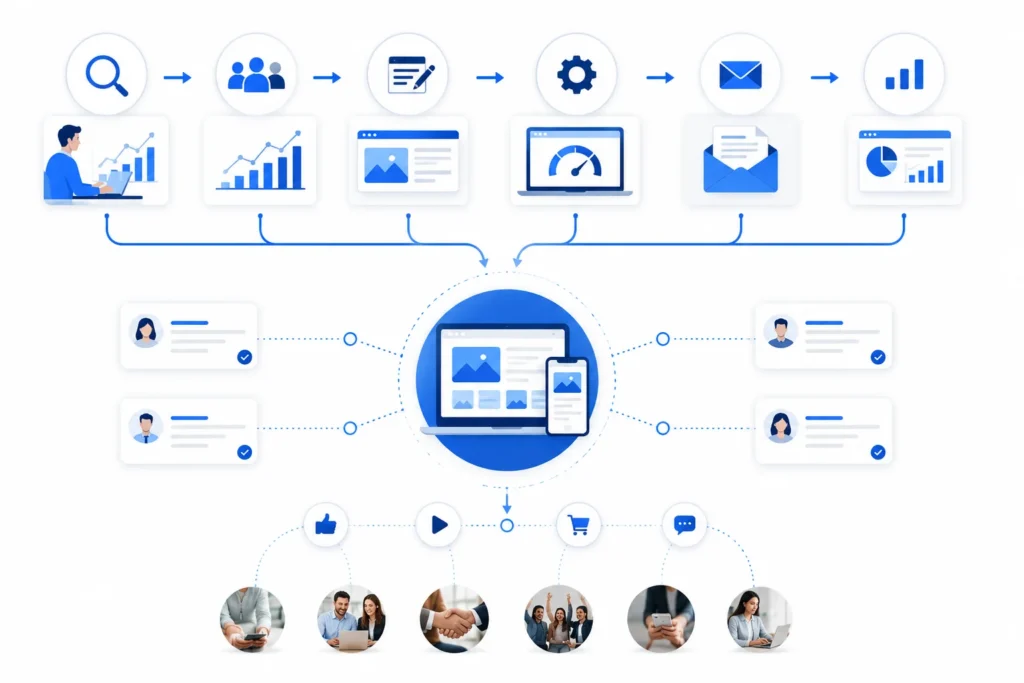
An experienced agency connects each activity into one strategy.
SEO attracts visitors.
Content answers their questions.
The website encourages them to take action.
Email marketing keeps them engaged.
Analytics measures every step of the customer journey.
This integrated approach is what helps small businesses achieve consistent, long-term growth instead of relying on isolated marketing efforts.
What Happens After You Hire a Digital Marketing Agency?
Many business owners assume that marketing begins with running ads or publishing social media posts. In reality, a professional agency starts by learning about your business.
The first few weeks are focused on research, planning, and identifying the best opportunities for growth. Skipping this stage often leads to wasted time and budget.
Although every agency has its own process, most follow a similar roadmap.
Step 1: Understanding Your Business
Before recommending any marketing strategy, an agency needs to understand your business.
This usually includes learning about:
- Your products or services
- Your ideal customers
- Your competitors
- Your unique selling points
- Your short-term and long-term goals
- Your current marketing efforts
Without this information, it’s difficult to create a strategy that delivers meaningful results.
How a Digital Marketing Agency Saves Small Business Owners Time
One of the biggest reasons small businesses hire a digital marketing agency isn’t because they can’t learn marketing. It’s because they don’t have enough time to manage it consistently while running their business.
Digital marketing requires ongoing work. Keyword research, website updates, content creation, campaign monitoring, performance reporting, and optimization all take time. When these tasks compete with customer service, sales, and daily operations, marketing often becomes inconsistent.
By handling these responsibilities, a digital marketing agency allows business owners to focus on running their business while experienced marketers manage the day-to-day marketing activities. This not only saves time but also helps ensure that marketing efforts continue without interruption.
Step 2: Auditing Your Current Online Presence
The next step is evaluating how your business performs online today.
An agency may review:
- Your website
- Google Business Profile
- Existing SEO
- Website speed
- Mobile experience
- Social media profiles
- Online reviews
- Current advertising campaigns
- Analytics data
This audit helps identify strengths, weaknesses, and quick improvement opportunities.
Practical Tip: Many small businesses discover that simple issues, such as slow page speed, missing calls to action, or outdated business information, are preventing potential customers from contacting them.
Step 3: Researching Your Market and Competitors
A successful marketing strategy isn’t based on assumptions.
Agencies research:
- What customers are searching for
- Which keywords have the highest value
- What competitors are doing well
- Content gaps in your industry
- Customer questions
- Market trends
This research helps prioritize the marketing activities most likely to generate results.
Step 4: Building a Marketing Strategy
Once the research is complete, the agency creates a plan that aligns with your business goals.
Instead of recommending every marketing service, a good agency identifies where your business will benefit the most.
The strategy often includes:
- SEO priorities
- Local SEO improvements
- Content plan
- Advertising strategy
- Website improvements
- Lead generation goals
- Monthly performance indicators
Every recommendation should support a measurable business objective.
Step 5: Launching Campaigns
After the strategy is approved, implementation begins.
Depending on your goals, the agency may:
- Optimize website pages
- Publish new content
- Launch Google Ads campaigns
- Improve local SEO
- Set up email marketing
- Create landing pages
- Manage social media campaigns
Not every activity starts on the same day. Agencies usually prioritize the actions that can have the greatest impact first.
Step 6: Measuring and Improving Results
Digital marketing is not a one-time project.
Every campaign should be monitored and improved based on performance.
An agency regularly reviews:
- Website traffic
- Lead quality
- Conversion rates
- Advertising costs
- Keyword rankings
- Customer behavior
The goal is continuous improvement rather than simply maintaining existing campaigns.
How a Digital Marketing Agency Builds a Marketing Strategy
Many people think digital marketing is about choosing a few marketing channels and hoping for the best.
Experienced agencies take a different approach.
They begin with business objectives and then build marketing around those objectives.
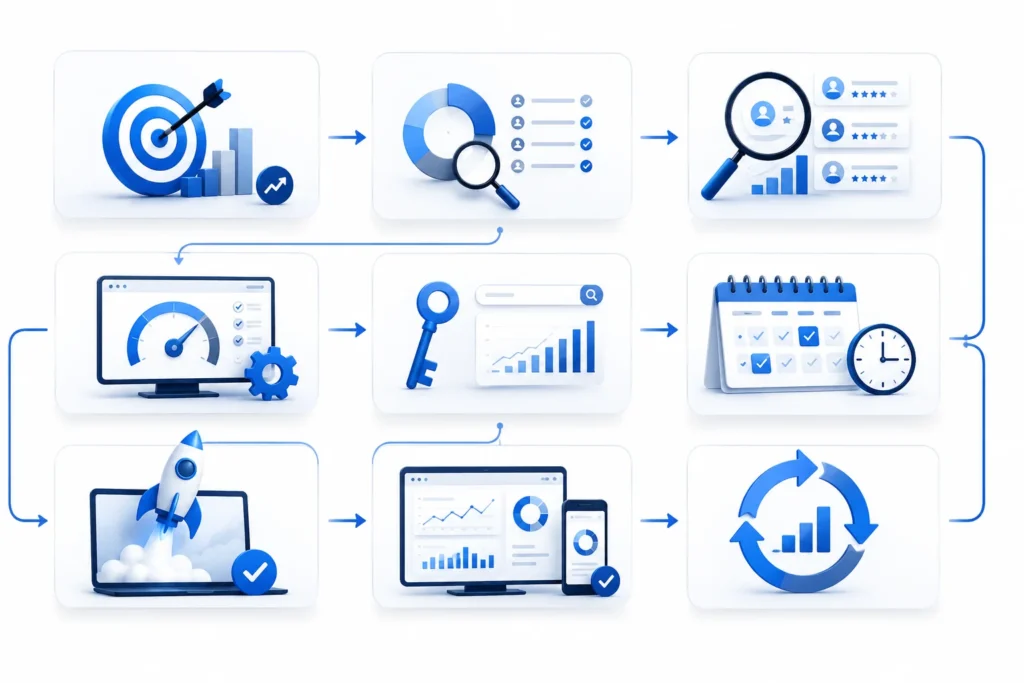
🗺️ A Typical Digital Marketing Strategy Roadmap
A successful digital marketing strategy follows a structured process. Each step builds on the previous one, creating a clear roadmap that helps businesses achieve measurable and sustainable growth.
Instead of chasing every marketing trend, the strategy focuses on activities that help your business achieve measurable growth.
How Agencies Prioritize Marketing Activities
A common misconception is that every business needs every marketing service from day one. In reality, experienced agencies usually prioritize the activities that can deliver the greatest impact first.
For example, a local plumbing company may benefit more from improving its Google Business Profile and Local SEO before investing heavily in content marketing. An e-commerce store, on the other hand, may see better results by focusing on product page optimization, search engine optimization, and paid shopping campaigns.
Rather than doing everything at once, agencies often build a phased strategy that matches the business’s goals, available budget, and growth stage.
Which Digital Marketing Services Should Your Business Prioritize First?
Not every small business needs every marketing service immediately.
Your priorities depend on your current challenges.
🎯 Which Digital Marketing Service Should You Prioritize First?
Not every small business needs every marketing service immediately. The best starting point depends on your biggest challenge and your business goals. Use this table as a quick guide.
| If Your Goal Is… | Start With… |
|---|---|
| 📈 Increase website traffic | SEO |
| 📍 Get more local customers | Local SEO |
| 🚀 Generate leads quickly | Google Ads |
| 🔁 Improve repeat business | Email Marketing |
| 📢 Build brand awareness | Social Media Marketing |
| 💰 Increase website conversions | Conversion Rate Optimization (CRO) |
| 📚 Educate your audience | Content Marketing |
Starting with the right service often delivers better results than trying to do everything at once.
Common Digital Marketing Mistakes Small Businesses Make

Many businesses invest in marketing but struggle because they focus on the wrong activities.
Here are some of the most common mistakes.
Trying Every Marketing Channel
It’s tempting to create accounts on every social media platform or invest in multiple advertising channels.
However, spreading your budget too thin usually reduces your results.
Focus on the platforms where your audience is most active.
Expecting Immediate Results
Digital marketing takes time.
Paid advertising can generate traffic quickly, but strategies like SEO and content marketing require patience and consistent effort.
Businesses that commit to long-term improvement often see stronger and more sustainable growth.
Ignoring Website Performance
Driving traffic to a slow or confusing website rarely produces good results.
Before increasing marketing efforts, make sure your website provides a positive user experience.
Measuring the Wrong Metrics
Likes and followers can be encouraging, but they don’t always translate into business growth.
Instead, focus on metrics that directly affect your business, such as:
- Qualified leads
- Sales
- Conversion rates
- Customer acquisition cost
- Return on investment
Creating Content Without a Strategy
Publishing random blog posts or social media updates rarely produces consistent results.
Every piece of content should answer customer questions, support your business goals, and fit into your overall marketing strategy.
Which Businesses Benefit Most from a Digital Marketing Agency?
Almost every business can benefit from digital marketing, but some industries depend heavily on online visibility.
Should You Hire a Digital Marketing Agency?
Not every business needs to hire an agency immediately. However, there are situations where professional support can make a significant difference.
You may benefit from working with a digital marketing agency if:
- Your website receives very little traffic.
- You’re struggling to generate consistent leads.
- Your competitors consistently outrank you in search results.
- You don’t have time to manage marketing yourself.
- Your advertising campaigns aren’t producing a positive return.
- You’re unsure which marketing strategy fits your business.
If several of these situations apply to your business, partnering with an experienced agency may help you achieve your goals more efficiently.
🏢 Which Businesses Benefit Most from a Digital Marketing Agency?
While almost every business can benefit from digital marketing, some industries rely more heavily on online visibility and lead generation than others. Here’s a quick overview of the marketing services that typically deliver the best results for each industry.
| Industry | Marketing Services That Often Deliver Strong Results |
|---|---|
| 🏠 Home Services | Local SEO, Google Ads, Online Reviews |
| 🦷 Dental Clinics | Local SEO, Website Optimization, Content Marketing |
| ⚖️ Law Firms | SEO, Google Ads, Content Marketing |
| 🍽️ Restaurants | Google Business Profile, Social Media Marketing |
| 🏡 Real Estate | SEO, Email Marketing, PPC Advertising |
| 🛒 E-commerce | SEO, Google Shopping Ads, Email Marketing |
| 💪 Fitness Centers | Local SEO, Social Media Marketing, Paid Advertising |
| 💼 Financial Services | Content Marketing, SEO, Lead Generation |
The exact strategy should always match the business’s goals, audience, and market.
How Do Digital Marketing Agencies Measure Success?
One of the biggest advantages of digital marketing is that almost every activity can be measured.
Instead of relying on guesswork, agencies use data to understand what’s working and where improvements are needed.
Here are some of the most important metrics.
Website Traffic
This measures how many people visit your website.
Increasing traffic is important, but attracting the right audience matters even more.
Conversion Rate
The conversion rate shows the percentage of visitors who complete an important action, such as submitting a contact form, making a purchase, or requesting a quote.
Improving conversion rates often increases revenue without increasing marketing costs.
Qualified Leads
Not every inquiry becomes a customer.
Qualified leads are potential customers who match your target audience and are more likely to purchase your products or services.
Cost Per Lead
This measures how much you spend to generate each new lead.
Lowering this cost while maintaining lead quality improves marketing efficiency.
Return on Investment (ROI)
ROI compares the revenue generated by marketing with the amount invested.
While every campaign has different goals, successful marketing should contribute to long-term business growth rather than simply increasing traffic.
What Makes a Great Digital Marketing Agency?
Not every agency delivers the same level of service. The best agencies focus on understanding your business before recommending solutions.
A reliable digital marketing agency should:
- Learn about your business goals.
- Understand your target audience.
- Explain its strategy in simple language.
- Provide regular performance reports.
- Measure success using meaningful business metrics.
- Adjust campaigns based on real data.
- Communicate openly throughout the partnership.
Rather than promising instant success, a good agency focuses on building sustainable growth through continuous improvement.
DIY vs. Hiring a Freelancer vs. Working With a Digital Marketing Agency
Many small business owners start by handling marketing themselves. This makes sense when budgets are limited. However, as the business grows, marketing becomes more complex and time-consuming.
Understanding the differences can help you make the right decision.
⚖️ DIY vs. Freelancer vs. Digital Marketing Agency
Choosing the right option depends on your budget, business goals, and the level of marketing support you need. Here’s a quick comparison to help you decide.
| Option | Best For | Advantages | Limitations |
|---|---|---|---|
| DIY Marketing | New businesses with a limited budget | ✔ Low cost ✔ Complete control |
Requires time, learning, and consistent effort. |
| Freelancer | Businesses needing one specific service | ✔ Flexible ✔ Affordable |
Usually specializes in one area only. |
| Digital Marketing Agency | Businesses focused on long-term growth | ✔ Access to specialists ✔ Complete marketing strategy ✔ Ongoing support |
Higher investment than DIY or hiring one freelancer. |
If your biggest challenge is creating a logo or writing a few blog posts, a freelancer may be enough.
However, if your goal is to generate more leads, improve search rankings, manage advertising, optimize your website, and measure performance, a digital marketing agency usually provides a more complete solution.
How Much Does a Digital Marketing Agency Cost?
There isn’t one standard price because every business has different goals, competition, and marketing needs.
For example, a local bakery and a national e-commerce brand require very different marketing strategies.
Below are general monthly investment ranges that many businesses use as a starting point.
💰 Typical Digital Marketing Agency Costs
Digital marketing agency pricing varies based on your business size, goals, industry, and the services you need. The table below shows general monthly investment ranges for small businesses.
| Business Type | Typical Monthly Investment |
|---|---|
| Startup | $500 – $1,500 |
| Small Local Business | $1,500 – $5,000 |
| Growing Business | $5,000 – $10,000 |
| Established Business | $10,000+ |
Note: These are general estimates for U.S. businesses. Actual pricing depends on your industry, competition, location, business goals, and the scope of services included in your marketing plan.
*These are general estimates. Actual costs vary depending on your industry, location, competition, and the services included.
Instead of asking, “What’s the cheapest agency?”, ask:
“Which agency can help my business achieve the best return on investment?”
The cheapest option isn’t always the most cost-effective if it fails to generate results.
How Long Does It Take to See Results?
This is one of the most common questions business owners ask.
The honest answer is that it depends on the marketing strategy.
Some channels produce results quickly, while others take time to build momentum.
⏳ How Long Does It Take to See Results?
Every marketing channel works at a different pace. While paid advertising can generate traffic quickly, strategies like SEO and content marketing require consistent effort before delivering long-term results.
| Marketing Activity | Typical Timeline |
|---|---|
| Google Ads | A few days to several weeks |
| Social Media Advertising | Days to weeks |
| Email Marketing | Immediate to a few weeks |
| Local SEO | Around 2–4 months |
| Search Engine Optimization (SEO) | Often 3–6 months or longer |
| Content Marketing | Several months of consistent publishing |
Key Insight: Every business is different. Your results will depend on factors such as your industry, competition, website quality, budget, and the consistency of your marketing efforts.
Businesses in highly competitive industries may need more time before seeing significant improvements.
The important thing is to focus on steady progress rather than expecting overnight success.
Practical Insight: More Marketing Doesn’t Always Mean Better Results
One of the most common misconceptions among small business owners is that success comes from using every available marketing channel. In reality, businesses often achieve better results by focusing on the channels that are most relevant to their audience.
For example, a local service business may see stronger results from Local SEO and Google Ads than from posting daily on multiple social media platforms. Similarly, an online store may benefit more from improving product pages and email marketing than from trying to build a presence on every social network.
The most effective marketing strategy is rarely the one that does the most. It’s the one that aligns with your business goals, target audience, and available resources.
Questions to Ask Before Hiring a Digital Marketing Agency
Choosing the right agency is just as important as deciding to hire one.
Before signing a contract, ask these questions.
What experience do you have with businesses like mine?
Industry experience isn’t always required, but it can help the agency understand your customers and competitors more quickly.
How will you measure success?
A professional agency should explain which key performance indicators (KPIs) it will track and how often you’ll receive reports.
Which services do you recommend first?
A trustworthy agency won’t try to sell every service immediately.
Instead, it should explain which marketing activities are likely to have the greatest impact based on your goals.
How often will we communicate?
Regular communication helps ensure your marketing strategy stays aligned with your business priorities.
Who owns the marketing assets?
You should understand who owns your website, advertising accounts, content, and analytics data.
Having access to these assets protects your business if you ever decide to change agencies.
Red Flags to Watch For
Not every digital marketing agency provides the same quality of service.
Watch for these warning signs.
- Promises of guaranteed #1 Google rankings.
- No clear explanation of their strategy.
- No regular reporting.
- Long contracts with little flexibility.
- Vague answers about performance.
- Hidden fees.
- No case studies or client references.
- Focus on vanity metrics instead of business results.
A reliable agency will explain its process, communicate openly, and set realistic expectations.
Is Hiring a Digital Marketing Agency Worth It?
For many small businesses, the answer is yes—but only if the agency understands your goals and creates a strategy that fits your business.
Hiring an agency doesn’t guarantee success.
Success comes from working with professionals who take the time to understand your audience, measure results, and continuously improve campaigns.
The right agency helps you avoid costly trial and error while allowing you to focus on running your business.
Frequently Asked Questions
What does a digital marketing agency actually do?
A digital marketing agency helps businesses attract customers online through services such as SEO, local SEO, paid advertising, content marketing, social media management, email marketing, website optimization, and performance tracking.
Do all small businesses need a digital marketing agency?
Not necessarily.
Some businesses successfully manage marketing in-house, especially during the early stages. However, as competition increases or marketing becomes more complex, working with an experienced agency can save time and improve results.
Which service should a small business invest in first?
That depends on your goals.
If you need immediate leads, paid advertising may be the best starting point. If you’re focused on long-term growth, SEO and content marketing are often strong investments. Local businesses usually benefit from improving their Google Business Profile and local SEO.
Can I do digital marketing myself?
Yes.
Many business owners begin by learning the basics and handling marketing themselves.
However, as your business grows, managing SEO, advertising, website optimization, content, and analytics together can become difficult without dedicated expertise.
Is SEO better than Google Ads?
Neither is universally better.
SEO focuses on long-term organic visibility, while Google Ads can generate traffic more quickly.
Many successful businesses use both together because they support different stages of growth.
How do I know if my marketing is working?
Look beyond likes and followers.
Measure results such as:
- Website traffic
- Qualified leads
- Conversion rate
- Revenue
- Cost per lead
- Return on investment
These metrics provide a better picture of marketing performance.
Can a digital marketing agency redesign my website?
Many agencies offer website design or optimization as part of their services.
They often improve site speed, mobile usability, navigation, and conversion-focused design to create a better user experience.
What should I expect during the first few months?
The first month is often focused on research, audits, and strategy.
Implementation usually begins after planning, with ongoing optimization based on performance data.
Meaningful improvements often build over time rather than appearing immediately.
Final Thoughts Before Choosing a Digital Marketing Agency
Hiring a digital marketing agency is an important business decision, and the right choice depends on your goals rather than the number of services an agency offers.
Before making a decision, think about the challenges your business is trying to solve. Do you need more qualified leads? Better local visibility? Higher website conversions? Or are you looking for a long-term strategy that supports steady business growth?
The answers to these questions will help you choose an agency whose expertise matches your needs. A successful partnership begins with clear expectations, realistic goals, and open communication from both sides.
These Are the Only Sections I’d Add
These additions strengthen the article without changing its structure because they fill the few remaining gaps left by both your draft and the competitor articles. Specifically, they:
- Add a concise Quick Answer for users and AI search.
- Explain how agencies save time, a practical benefit often overlooked.
- Clarify how agencies prioritize marketing activities, rather than doing everything at once.
- Help readers decide whether they actually need an agency.
- Define what separates a great agency from an average one.
- Include an experience-informed practical insight that supports EEAT.
- End with a decision-focused section that prepares readers for the conclusion.
I would not add any more sections beyond these. Any additional headings would likely repeat information already covered and could dilute the article rather than improve it.
Conclusion
Growing a small business isn’t just about working harder—it’s about making smarter decisions with your time, budget, and marketing efforts.
One pattern appears repeatedly among successful businesses. They don’t try to master every marketing channel or chase every new trend. Instead, they focus on understanding their customers, building a clear strategy, and improving it consistently over time.
That’s the real value of a digital marketing agency.
A good agency doesn’t simply manage social media accounts or launch advertising campaigns. It helps you understand where your best opportunities are, builds a strategy around your business goals, and measures success using real business outcomes instead of guesswork.
If you’re considering hiring a digital marketing agency, don’t focus only on the list of services it offers. Ask how it plans to solve your specific challenges, how it measures success, and how it will support your long-term growth.
Whether you choose to manage marketing yourself, hire a freelancer, or partner with an agency, the most important takeaway is this: sustainable business growth comes from a thoughtful strategy, consistent execution, and continuous improvement.
When marketing decisions are guided by data, customer needs, and clear objectives, your business is in a much stronger position to build lasting visibility, attract qualified customers, and grow with confidence.
If you’d like to learn more about SEO, content marketing, and online business growth, explore our latest digital marketing insights on TheWritePosts.com.